
Report - No Bailouts for Big Tech Billionaires: Policies for when the AI bubble bursts
Overview
Twenty years ago, the U.S. economy morphed into a huge bet on the frothy housing market. The bubble’s animating narrative was simple: housing prices had been rising for a long time, and they would continue to do so. Enticed by the fees they earned for originating mortgages and selling them to banks, lenders increasingly extended credit to borrowers who, as even a cursory look through their finances would have revealed, simply were not earning enough money to cover the debts they were assuming. The result was a classic speculative bubble, the size and risks of which were largely hidden from policymakers due to lax transparency requirements, deceptive accounting, and the fact that much of the riskiest debt had been disguised through financial chicanery and a largely unregulated shadow banking sector.
Despite numerous warning signs, policymakers did not wake up to the danger until the financial system started to unravel. Fearing that inaction would wreck the economy, policymakers orchestrated a series of escalating bailouts, starting with Bear Stearns, followed by Fannie Mae and Freddie Mac, then AIG, and finally Wall Street as a whole. Bailout funds, with extremely favorable conditions for the distressed companies, went to some of the largest and most powerful corporations in the world and were pushed through with little opportunity for public input. Public outrage to the bailouts followed, but the damage — not only to the economy, but to policymakers’ credibility — had been done.
Today, the economy again resembles a huge bet on a market that bears all the signs of a speculative bubble, this time centered on the artificial intelligence (AI) industry. Companies are spending trillions (yes, trillions) of dollars on infrastructure and resources to develop, train, and run generative AI models, particularly chatbots powered by large language models (LLMs).[1] AI companies are taking on massive amounts of debt to finance their spending even though the revenues from selling generative AI products and services would have to grow by orders of magnitude within the next few years to pay those debts. The extent of the risk is, once again, difficult to determine because of poor transparency, deceptive accounting, and the heavy involvement of the shadow banking sector.
Perhaps recognizing the precariousness of their situation, some industry actors have already started dropping hints that the industry might seek government assistance. In November 2025, OpenAI Chief Financial Officer Sarah Friar floated a federal government “backstop” for AI infrastructure investments, citing AI’s economic importance and the need for the U.S. to maintain its technological lead over China, before walking her comments back after public outrage.[2] Weeks later, venture capitalist and White House AI Czar David Sacks tweeted: "AI-related investment accounts for half of GDP growth. A reversal would risk recession. We can’t afford to go backwards.”[3]
These are not the sort of statements one would expect from people confident about their industry’s financial strength. They are, however, exactly what one might expect from people who suspect their industry will need a bailout in the not-too-distant future.
The AI bailout movement thus has begun, albeit in a quiet and veiled form. We should expect AI bailout pleas to increase in frequency and urgency if and when it becomes apparent that the bubble has burst and the promised AI revolution will take longer than promised to arrive. And that’s assuming it ever arrives at all.
Even if arguments for an AI bailout had merit, politicians would have ample reason to be wary of them. The bailouts in the wake of the last financial crisis proved unpopular across the political spectrum.[4] The data centers at the heart of the current bubble are already becoming a magnet for political opposition in many communities, as even the tech industry has been forced to admit.[5] Providing a bailout to a deeply unpopular industry because it overspent on deeply unpopular infrastructure would be, well, deeply unpopular.
Fortunately, this is a case where good politics and good policy align. The goal of this report is to analyze the arguments that could be (and in some cases have been) advanced in favor of an AI industry bailout and explain why they are meritless. My hope is that, armed with this report, policymakers will be able to recognize AI bailout requests for what they are: the self-serving efforts of powerful corporations to make others absorb the losses from their dubious gamble
TABLE OF CONTENTS
Overview
Part I: The AI Bubble
A. Bubble fuel: AI hype
B. Anatomy of the bubble: Everything’s big but the revenues
Part II: What are Bailouts?
A. Block framework
B. A brief history of bailouts
C. Bailout consequences: The big get bigger and the rich get richer
D. Bailout justifications
Part III: Rebutting (and Prebutting) the AI Industry’s Bailout Arguments
A. Importance arguments
B. Worthiness arguments
Part IV: What We Should Do Instead
A. Let failing companies fail
B. Rescue the real economy
C. Prevent a recurrence
Conclusion
Credits
Author
Matthew U. Scherer
Project Director
Courtney Radsch
Contributors
Anita Jain
Sandeep Vaheesan
Max Von Thun
Acknowledgements
The author thanks Advait Arun, Brian Chen, Damon Silvers, Jake Snow, and Shu Dar Yao for their feedback and support.
Epigraph
We have created an ersatz capitalism, socializing losses as we privatize gains, a system with unclear rules, but with a predictable outcome: future crises and undue risk-taking at public expense.
- Joseph Stiglitz, 2010
Overview
Twenty years ago, the U.S. economy morphed into a huge bet on the frothy housing market. The bubble’s animating narrative was simple: housing prices had been rising for a long time, and they would continue to do so. Enticed by the fees they earned for originating mortgages and selling them to banks, lenders increasingly extended credit to borrowers who, as even a cursory look through their finances would have revealed, simply were not earning enough money to cover the debts they were assuming. The result was a classic speculative bubble, the size and risks of which were largely hidden from policymakers due to lax transparency requirements, deceptive accounting, and the fact that much of the riskiest debt had been disguised through financial chicanery and a largely unregulated shadow banking sector.
Despite numerous warning signs, policymakers did not wake up to the danger until the financial system started to unravel. Fearing that inaction would wreck the economy, policymakers orchestrated a series of escalating bailouts, starting with Bear Stearns, followed by Fannie Mae and Freddie Mac, then AIG, and finally Wall Street as a whole. Bailout funds, with extremely favorable conditions for the distressed companies, went to some of the largest and most powerful corporations in the world and were pushed through with little opportunity for public input. Public outrage to the bailouts followed, but the damage — not only to the economy, but to policymakers’ credibility — had been done.
Today, the economy again resembles a huge bet on a market that bears all the signs of a speculative bubble, this time centered on the artificial intelligence (AI) industry. Companies are spending trillions (yes, trillions) of dollars on infrastructure and resources to develop, train, and run generative AI models, particularly chatbots powered by large language models (LLMs).[1] AI companies are taking on massive amounts of debt to finance their spending even though the revenues from selling generative AI products and services would have to grow by orders of magnitude within the next few years to pay those debts. The extent of the risk is, once again, difficult to determine because of poor transparency, deceptive accounting, and the heavy involvement of the shadow banking sector.
Perhaps recognizing the precariousness of their situation, some industry actors have already started dropping hints that the industry might seek government assistance. In November 2025, OpenAI Chief Financial Officer Sarah Friar floated a federal government “backstop” for AI infrastructure investments, citing AI’s economic importance and the need for the U.S. to maintain its technological lead over China, before walking her comments back after public outrage.[2] Weeks later, venture capitalist and White House AI Czar David Sacks tweeted: "AI-related investment accounts for half of GDP growth. A reversal would risk recession. We can’t afford to go backwards.”[3]
These are not the sort of statements one would expect from people confident about their industry’s financial strength. They are, however, exactly what one might expect from people who suspect their industry will need a bailout in the not-too-distant future.
The AI bailout movement thus has begun, albeit in a quiet and veiled form. We should expect AI bailout pleas to increase in frequency and urgency if and when it becomes apparent that the bubble has burst and the promised AI revolution will take longer than promised to arrive. And that’s assuming it ever arrives at all.
Even if arguments for an AI bailout had merit, politicians would have ample reason to be wary of them. The bailouts in the wake of the last financial crisis proved unpopular across the political spectrum.[4] The data centers at the heart of the current bubble are already becoming a magnet for political opposition in many communities, as even the tech industry has been forced to admit.[5] Providing a bailout to a deeply unpopular industry because it overspent on deeply unpopular infrastructure would be, well, deeply unpopular.
Fortunately, this is a case where good politics and good policy align. The goal of this report is to analyze the arguments that could be (and in some cases have been) advanced in favor of an AI industry bailout and explain why they are meritless. My hope is that, armed with this report, policymakers will be able to recognize AI bailout requests for what they are: the self-serving efforts of powerful corporations to make others absorb the losses from their dubious gamble.
For purposes of this report, “AI industry” is an umbrella term encompassing the many companies involved in the interconnected parts of the AI development, training, and operation pipeline, including:
- “Pure play” AI model development companies like OpenAI and Anthropic that focus exclusively on developing their own AI models.
- Big Tech conglomerates that develop their own AI models, most notably Google and Meta. Amazon and Microsoft also develop their own AI models, though they are not in widespread use.
- Companies offering AI products and services using models developed by others.
- Chip developers that produce the hardware used to train and run AI models, most notably Nvidia.
- Cloud service providers, including legacy providers like Amazon Web Services, Microsoft Azure, Google Cloud, and Oracle, as well as AI-focused “neocloud” providers like CoreWeave and Nebius.
- Data center and infrastructure companies that build, operate, or lease the facilities that physically house cloud services and AI infrastructure.
- Financial institutions, particularly venture capital and private credit firms, that help finance these companies’ activities.
This report focuses on the U.S. AI industry and its implications for U.S. policy.
Part I provides an overview of the AI bubble, starting with the narrative hype that has inflated it. It continues with a high-level overview of the bubble’s key economic features, starting with the remarkable valuations of AI-focused tech companies, in which more wealth is tied up than any single industry in history. The report then describes how AI companies are rapidly accumulating debt as they continue to spend orders of magnitude more than they generate in revenues and analyzes the suspect accounting practices that the AI industry is using to obscure its precarious finances.
Part II describes the characteristic features of a bailout using the framework proposed by legal scholar Cheryl Block, who categorized bailouts into overt (like purchases of stock and loan guarantees) and covert (like relief from taxes or other legal obligations) forms. It then provides a brief history of federal government bailouts, highlighting the justifications that were made for each. Those justifications serve as the focus of Part II’s final section, which observes that bailouts are usually justified by a combination of arguments relating to the bailed-out companies’ importance (such as being too big or strategically important to fail, or the possibility that a company’s collapse will cause economic contagion) and worthiness (typically that the companies are financially sound and/or were innocent victims of some external shock).
Part III describes the arguments AI companies will most likely advance to seek a bailout when the AI bubble bursts and rebuts each argument in turn. Briefly, I argue that the AI industry, its hype notwithstanding, is neither strategically important nor vital to the U.S. economy; that tech companies are not like banks, and their collapse would not pose a comparable risk of financial contagion; and that any negative consequences that follow from an AI crash would be better dealt with through other policy approaches. Part IV briefly describes some of those approaches, although a fulsome exploration of those measures is outside the scope of this report.[7]
The report concludes with a reminder of the reason why bailouts are almost always the wrong response to manmade economic crises: such bailouts undermine confidence in democratic institutions while encouraging the sort of excessive risk-taking that sows the seeds for even more severe crises in the future.
Part I: The AI Bubble
A. Bubble fuel: AI hype
In their 2019 book Bubbles and Crashes,[8] Brent Goldfarb and David Kirsch analyzed the history of bubbles and identified four key factors that drive their formation. One of those factors is the creation of powerful narratives around new technologies, particularly narratives that “foster an illusion of inevitability” about a technology’s revolutionary potential.[9] Such narratives tend to be self-reinforcing. “The more people who jump on a particular narrative’s bandwagon, the more real this illusion seems and even becomes,”[10] Goldfarb and Kirsch write. The problem with such narratives is that they lead investors to overlook a technology’s shortcomings.
If narratives are bubble fuel, then generative AI’s tank is overflowing. As New York Times journalist David Streitfeld summarized:
Silicon Valley executives promise that artificial intelligence is going to radically change everyone’s life for the better, starting just a few minutes from now. A.I. is described as the new electricity. It’s even bigger than fire. Don’t bother saving money for retirement because everyone will be rich rich rich.[11]
Such hype has been building for over a decade. As far back as 2015, commentators were talking about AI and related technologies as having the potential to bring about a “Fourth Industrial Revolution” matching or exceeding in importance the advances in manufacturing, electricity, and information technology that defined prior economic transformations. After the arrival of ChatGPT on November 30, 2022, these narratives coalesced around LLM-driven chatbots and related generative AI systems.
Leveraging public awe at LLMs’ ability to output fluent text, AI boosters have argued that the technology is approaching what could be considered “artificial general intelligence” (AGI), a once-fringe and still ill-defined term for technology capable of matching humans in all cognitive tasks. An even more obscure term, superintelligence, used to describe AI systems that will vastly exceed human capabilities in every meaningful way, soon entered common parlance as well. In 2025, Meta renamed its frontier AI research program the “Superintelligence Lab.”
Not content with suggesting that a technological revolution is inevitable or imminent, AI industry leaders have increasingly taken to claiming that it has already begun. In 2023, a Google Vice President asserted that AGI had been achieved,[12] a claim that Nvidia CEO Jensen Huang repeated earlier this year.[13] OpenAI CEO Sam Altman suggested in 2024 that superintelligence would be reached within “a few thousand days.”[14] Shortly before the release of GPT-5 in August 2025, he said that talking to the new version of ChatGPT would be like talking to “a legitimate PhD-level expert in anything, any area you need.”[15]
The hype is not limited to abstract characterizations of AI capabilities. The AI industry is pushing the narrative that AI can already perform the jobs of millions of workers or will soon be able to do so. In a remarkably specific prediction, Anthropic CEO Dario Amodei said in March 2025 that over 90% of code would be written by AI within three to six months.[16] The failure of that and similar forecasts seems to have little effect. Earlier this year, Microsoft AI chief Mustafa Suleyman claimed that “most, if not all” professional white-collar tasks will be “fully automated by an AI within the next 12 to 18 months.”[17]
Social media has likewise become a playground for AI hype, with numerous influencers suggesting that the transformation of entire industries due to generative AI is underway. Earlier this year, it came to light that AI companies are paying some influencers hundreds of thousands of dollars each to boost AI on social media.[18]
One would think that the revelation of the existence of an AI propaganda industry would instill a sense of caution, but, if anything, the velocity at which AI hype travels seems to be accelerating. In February 2026, a post went viral on LinkedIn and X by Matt Shumer, CEO of a startup called OthersideAI, claiming that self-improving AI had already arrived and had rendered many knowledge workers’ skills obsolete.[19] The post, titled “Something Big Is Happening,” racked up tens of millions of views and considerable credulous press attention[20] despite Shumer’s obvious conflict of interest and the fact that he had previously made false claims about AI capabilities.[21] Later that month, stock markets tanked after Citrini Research, a previously obscure market research firm, published a “report” discussing a purely speculative scenario where advanced AI agents displace millions of white collar workers in 2028.[22]
Press coverage of the Shumer and Citrini pieces illustrates how the news media has frequently fed into the AI hype cycle by publishing stories that uncritically repeat pro-AI messaging. A meta-analysis of media representations of AI concluded that they “are predominantly positive, using economic framing and giving voice to established, institutional and often economic stakeholders” while “critical perspectives and the limitations of AI technologies receive considerably less attention.”[23] According to journalism professor Rasmus Klein Nielsen, coverage of AI “tends to be led by industry sources, and often takes claims about what the technology can and can’t do, and might be able to do in the future, at face value in ways that contribute to the hype cycle.”[24]
Examples abound. An April 2023 60 Minutes segment reported as fact claims by Google executives that AI had learned Bengali despite not being trained on it. In reality, the system had trained on thousands of Bengali texts.[25] In July 2025, The Economist ran a cover story titled “The Economics of Superintelligence,” arguing that a future where superintelligent AI unlocked explosive economic growth was the “immediate, probable, [and] predictable” result of advances in AI,[26] despite the complete absence of evidence that superintelligence is attainable, or even a coherent concept.[27]
Stories with a more skeptical tone occasionally appear, such as Stretfield’s New York Times piece quoted at the beginning of this section. Unfortunately, the same outlets frequently repeat AI hype narratives without words of caution. The same week that the New York Times ran Stretfield’s article, it also published an op-ed by the CEO of “an A.I.-powered software acceleration platform.” Its headline (“The A.I. Disruption We’ve Been Waiting for Has Arrived”) and tone (“The simple truth is that I am less valuable than I used to be” and “No matter where you work, my hunch is this is coming for you”) were only slightly less breathless than that of Shumer’s essay.[28] The very same day, the Times released a podcast where Times tech reporter Kevin Roose predicted that within a year, “dramatically better” AI agents will be “full-fledged members of the workforce” such that “there will be this new kind of company that is emerging with AI work at the center of it, and I think that’s going to be a really fast growing part of the economy.”[29]
B. Anatomy of the bubble: Everything’s big but the revenues
Unsurprisingly, these wildly inflated expectations have driven speculative investment in AI — even though, the immense hype notwithstanding, generative AI companies have not figured out how to profit from the technology. The result has been a stark split screen: AI companies (1) enjoy unprecedented valuations while (2) burning through equally unprecedented amounts of cash with little to show for it. AI companies are increasingly resorting to questionable accounting methods, including some that are obviously deceptive, to inflate their revenues and mask rapidly growing piles of debt.
1. Valuations
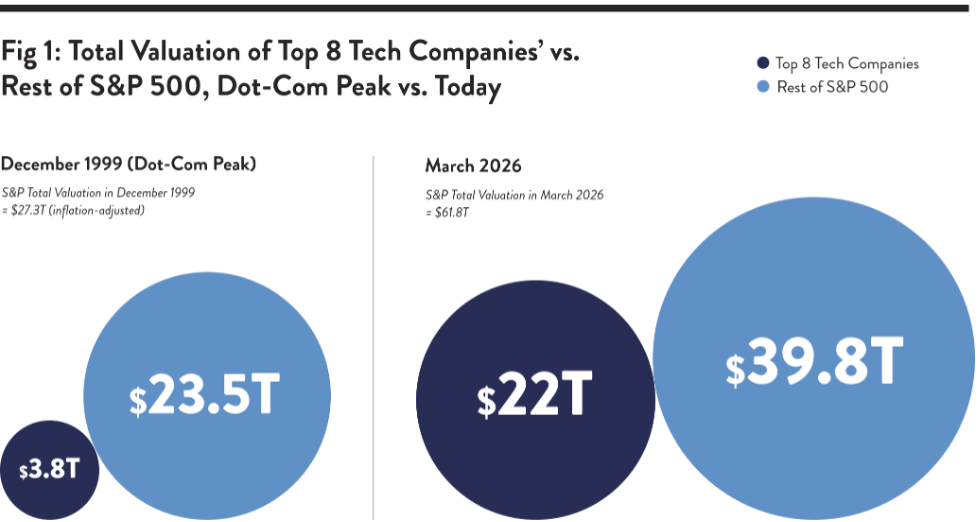
The stock market has never been as concentrated in a small number of closely connected companies as it is today. Currently, nine of the 10 most valuable companies in the world are tech companies (the 10th is Saudi Aramco), eight of which are based in the United States (the other is Taiwan’s TSMC, which manufactures AI chips). The eight U.S. companies (Nvidia, Microsoft, Apple, Alphabet, Amazon, Broadcom, Meta, and Tesla, in order of their market capitalization) are collectively valued at $22 trillion as of March 5, 2026, accounting for 36% of the S&P 500.[30]
By comparison, even at the peak of the dot-com bubble, only three of the top 10 global companies by market cap were U.S. tech companies, and the top eight U.S. tech companies at that time (Microsoft, Cisco, Intel, IBM, Oracle, Qualcomm, AT&T, and Verizon) combined to make up just 15% of the S&P 500’s total value, less than half the current share (see Figure 1).[31] One must go back to the mid-1800s, when railroads dominated equity markets, to find the last period of such extreme sectoral concentration.[32]
Today's biggest tech companies are also more interconnected than their dot-com era counterparts. In particular, today's tech giants are all deeply exposed to an LLM downturn. Among the eight largest companies in the country, six focus on either developing and deploying their own LLMs (Meta), providing goods or services to LLM developers (Nvidia, Broadcom), or both (Alphabet, Amazon, Microsoft). The other two (Apple and Tesla) are aggressively incorporating LLMs into their products and services.
A stock market crash would likely have a bigger economic impact today than ever before. During the late 19th century railroad bubble, U.S. stock markets were worth less than half of U.S. GDP.[33] That ratio exceeded 100% for the first time during the run-up to the 1929 stock market crash and reached a new high of 150% at the peak of the dot-com bubble.[34] Today, that ratio is over 210%, having risen by over 70 percentage points since the launch of ChatGPT in November 2022.[35] That means U.S. stock markets are now worth more than double what the entire country produces in a year.
Additionally, roughly 60% of Americans own stock, more than at any point since records began, meaning that the economic pain from a stock market crash will directly affect more people than ever before.[36] By comparison, the stock ownership rate was just 10% at the time of the 1929 stock market crash.[37]
And that is just in the stock markets. OpenAI is still privately held, meaning that its shares are not sold on stock exchanges or otherwise available to the public, but it is more valuable than all but 15 companies in the world. The combined value of OpenAI ($840 billion) and Anthropic ($380 billion) tops $1.2 trillion,[38] more than any non-tech company in the world besides Saudi Aramco. Compare that to the dot-com era, when tech companies were also overhyped. When Amazon went public in 1997, it was considered massive for a private company at the time, with a valuation of $300 million (or $613 million in 2026 dollars).[39] That is not even one-tenth of one percent of OpenAI’s valuation today.
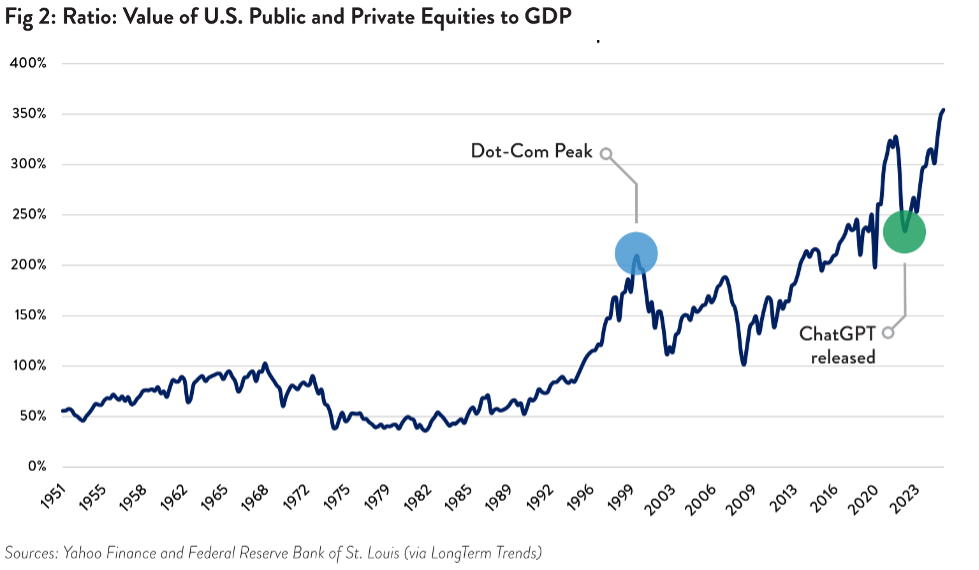
Combining both publicly traded and privately held companies, U.S. equities are now worth 354% of GDP, vastly higher than its previous dot-com era peak of 210%.[40] (See Figure 2)
2. Lots of spending (but little in revenues)
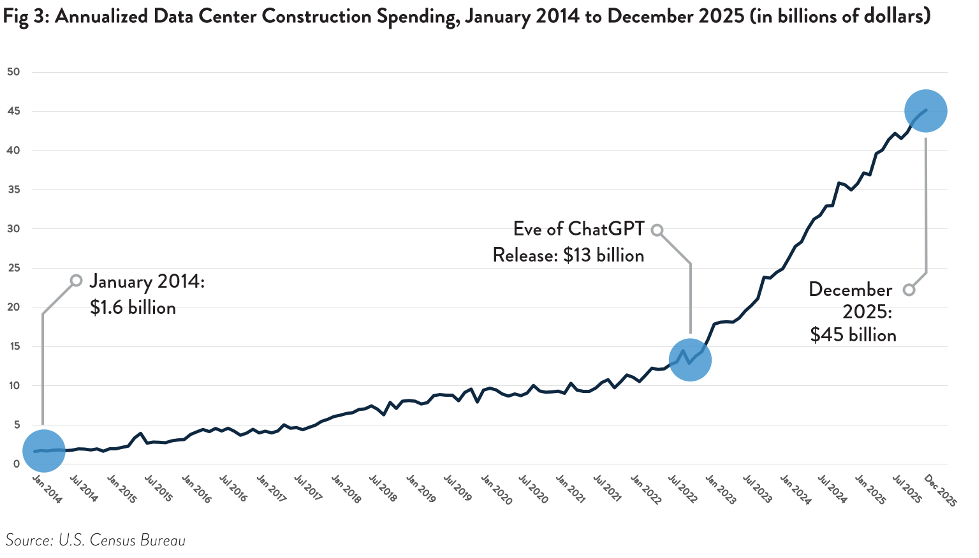
The exorbitant valuations of AI companies are accompanied by equally exorbitant spending on AI infrastructure. AI companies are splurging on data centers containing server racks filled with specialized chips that perform the complex calculations necessary to train and run generative AI models. In January 2014, the Census Bureau began tracking data center construction spending in the United States (see Figure 3).[41] That month, annualized[42] spending on data centers was $1.6 billion. That slowly rose to $13 billion in October 2022, the eve of ChatGPT’s release, before surging to more than $20 billion in November 2023, $30 billion in May 2024, and $40 billion in May 2025. In December 2025, the last month for which data are available, it crossed $45 billion — exceeding, for the first time, the amount spent on office construction.[43]
Data center spending is set to rise still further in the coming years, largely driven by so-called “hyperscalers,” the term for the huge corporations that are spending the most on chips, data centers, and related AI infrastructure. Just five such hyperscalers — Alphabet, Amazon, Meta, Microsoft, and Oracle — plan to spend $770 billion on data centers and related AI capital expenditures in 2026 alone.[44] By 2030, Deutsche Bank predicts that the total amount spent on data center infrastructure will reach $4 trillion, more than 10 times the inflation-adjusted cost of NASA’s Apollo moon-landing program.[45] About 75% of hyperscalers’ infrastructure spending goes toward AI-specific items like AI-optimized GPUs, servers, networking equipment, and data centers.[46]
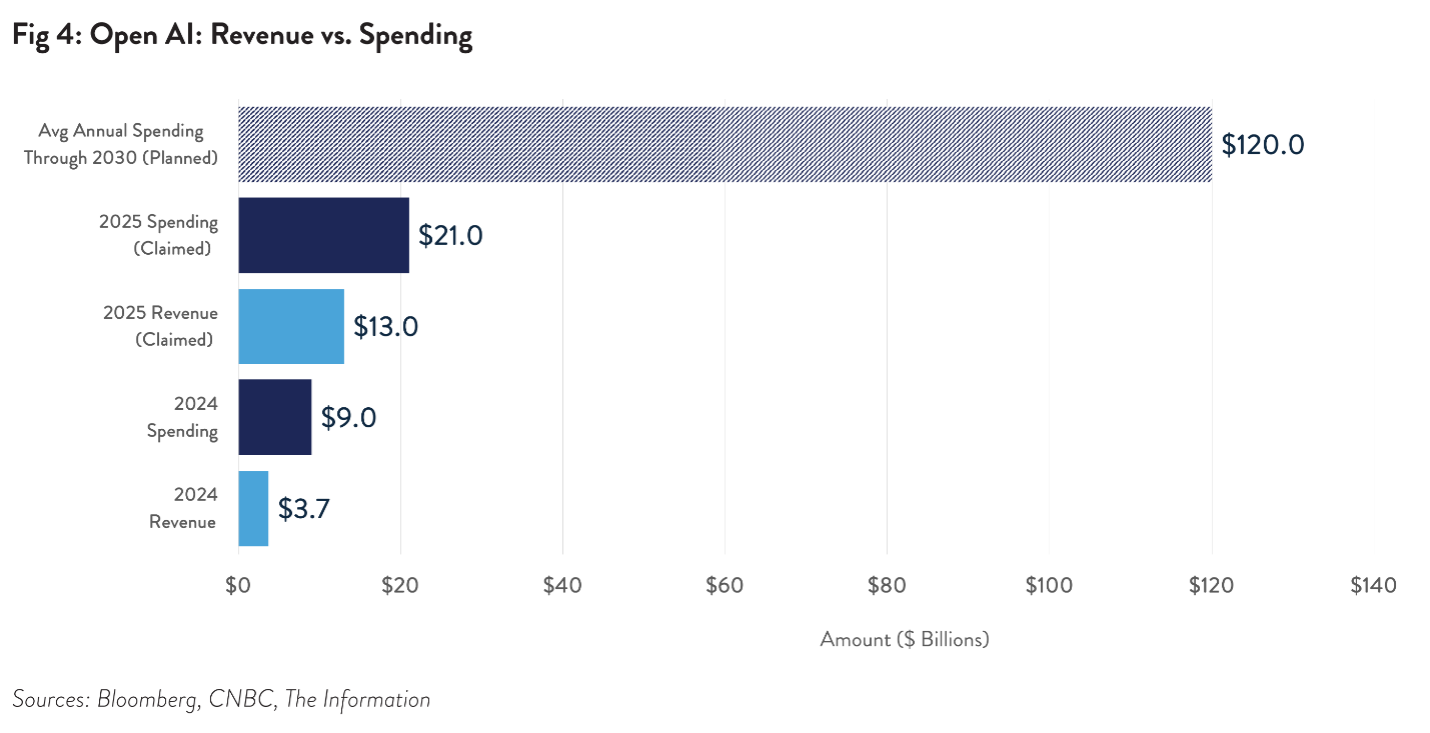
So far, however, the massive investments have not come close to generating any profits for the companies that make or sell AI tools. Generative AI has instead proven to be, in the words of technology writer Ed Zitron, a “cash incinerator.”[47] OpenAI claimed to have generated $13 billion in 2025, although there are ample reasons to question how much of this is revenue for actual AI services.[48] Reporting indicates that while 70% of OpenAI’s revenue comes from ChatGPT subscriptions, only 5% of ChatGPT users pay for the service.[49] This bodes poorly for OpenAI’s future revenue prospects because early adopters tend to be both more enthusiastic about a new technology and more willing to pay for cutting-edge features.[50] Nevertheless, OpenAI plans to spend an average of $120 billion per year on capital expenditures between now and 2030.[51]
The hyperscalers are likewise spending massive sums of money on AI infrastructure with little revenue to show for it. The five biggest hyperscalers (Alphabet, Amazon, Meta, Microsoft, and Oracle) earned an estimated $25 billion in AI-related revenue in 2025, just 4% of what they plan to spend on AI infrastructure in 2026.[52]
3. The debt deluge
How can an industry that appears to be bringing in 11 digits worth of annual revenue hope to cover 13 digits worth of spending on infrastructure? Until the fall of 2025, the AI boom was mostly financed through the enormous cash flows that tech giants draw from their pre-AI monopolies and oligopolies, supplemented by investments from venture capital and private equity funds. But as spending continued to rise without corresponding increases in revenue, AI companies began turning to debt — lots of it and from every corner of the financial system.
The explosion of debt in the AI ecosystem has become “all-consuming,” extending to every corner of debt markets.[53] The first 10 months of 2025 saw $125 billion in new debt tied to AI infrastructure projects, more than seven times the amount issued during the same period in 2024.[54] AI-linked companies have likewise issued nearly seven times as much in convertible bonds (a type of debt that can be converted to stock) during the first weeks of 2026 compared to the same period in 2025.[55]
Much of the borrowed money is also coming from private credit, a largely opaque and unregulated part of the debt market (sometimes called the “shadow debt” market). In these markets, private equity fund managers take the place of banks and the funds come from insurance companies, pension funds, and the ultra-rich. Private credit was a rounding error in the global financial system before the financial crisis, but it passed $1 trillion for the first time in 2020[56] and has more than tripled over the past six years to more than $3 trillion today.[57] About $800 billion of new private credit debt is projected to go towards building out AI data centers over the next three years.[58]
4. Funny accounting
Historically, dubious accounting methods have been a hallmark of bubbles. Some accounting tricks make a company’s earnings appear much healthier (or much less troubling) than they actually are. During the dot-com bubble, companies started using circular arrangements (called “vendor financing”) where Company A pays Company B to buy Company A’s own products or services. This creates the illusion that both companies are generating new revenues when, in reality, they are simply passing the same money back and forth.
Other machinations can hide sources of risk — especially mounting debts. Just as circular financing can obscure paltry revenues, the use of shell companies (also called “special-purpose vehicles” or SPVs) can obscure reckless borrowing and spending. Enron infamously made liberal use of SPVs to hide debt before its bankruptcy, and Citigroup moved more than $100 billion to SPVs to conceal the scale of the bets it had placed on the housing market during the run-up to the 2007-2008 financial crisis.[59]
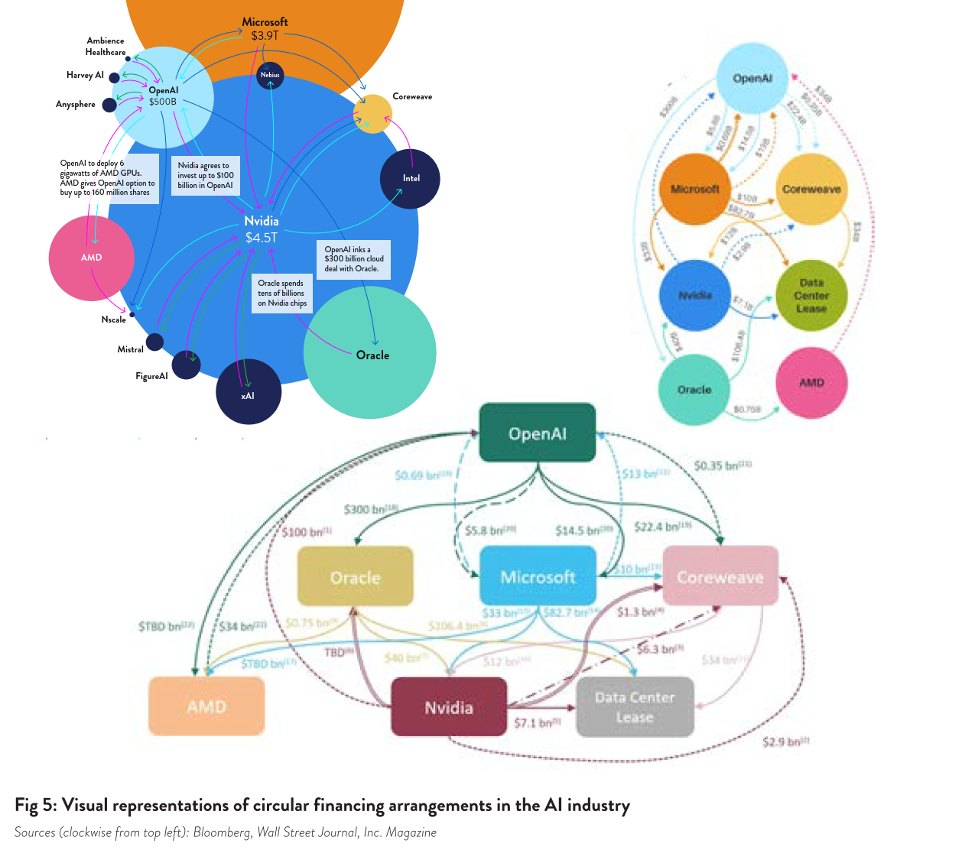
The AI industry is leaning on these techniques and adding a few of their own to obscure the shakier parts of their finances. The web of circular financing surrounding AI companies is a sight to behold — quite literally, in the sense that one must actually look at visual representations (such as those in Figure 5) of the incestuous relationships between the players in the AI ecosystem to begin to appreciate their extent. Such circular arrangements allow AI companies to report inflated revenues while making it more difficult to determine how much of their revenues come from selling actual AI-based products and services to businesses and consumers.
Shell companies are having another moment as well, with companies increasingly placing their AI-focused data centers (and the enormous loans used to finance them) in the hands of SPVs. Meta and Oracle are using SPVs to purchase chips and finance the construction of data centers without weighing down the balance sheets released to the public.[60] To build one data center, Meta worked with Morgan Stanley and private credit giant Blue Owl Capital to raise $30 billion in debt that is being parked in an SPV.[61]
Given the sheer magnitude of the gap between their revenues and their spending, however, AI companies are having to get even more creative. In recent years, Alphabet, Meta, Microsoft, and Oracle have extended the period over which they depreciate their AI chips, in essence claiming on their balance sheets that the chips will have a useful life of five to six years when they are, in reality, replacing the chips every two to three years.[62] That replacement cycle may be accelerating, with Nvidia now releasing new chips every year.[63]
By extending the depreciation period, companies can spread the cost of the chips over a longer period of time on their balance sheets, which makes it appear that they are spending far less each year than they actually are. Investor Michael Burry, who was among the first to recognize the mid-2000s housing bubble and was depicted by Christian Bale in the 2015 movie The Big Short, estimates that hyperscalers are using this technique to understate their expenses by a combined $176 billion over the next three years — with Microsoft (13%), Alphabet (14%), Amazon (21%), Meta (24%), and Oracle (48%) all overstating their profits by double digits.[64]
All these accounting tricks have been enabled by lax corporate transparency and accounting rules, which policymakers never fully addressed with legislation after the early 2000s Enron scandal demonstrated the ease with which corporations can manipulate the financial numbers they release to the public.[65] It is even easier for privately held companies like OpenAI and Anthropic to fiddle with their numbers because, unlike corporations traded on public stock exchanges, they need not release quarterly earnings statements reviewed by (at least theoretically) independent auditors. Instead, private companies can cherry-pick what numbers they release and when they release them. This allows, for example, OpenAI to report “revenues” by waiting until they have an unusually lucrative 30-day period, multiplying their revenues from that period by 12, and reporting the number as their “annualized” revenues — even if the reported number is far less than the company actually earns in any 12-month period.
Needless to say, companies rarely resort to these techniques if they are on solid financial footing; no one uses accounting tricks to hide healthy finances. The widespread use of such dubious accounting methods should be viewed as a major red flag for the AI industry’s financial health.
Part II: What are Bailouts?
The term “bailout” has maritime origins that still serve as a neat way of illustrating what the term means. In its original and most literal sense, “bailing out” is using a bucket to remove water from a boat that is becoming inundated. The idea is that by removing some of the water weighing the vessel down, the rescuers can preserve it until it can be repaired. Of course, if the damage is serious enough, the boat will sink despite the rescuers’ best efforts to bail it out. In that case, rather than wasting time and resources to keep the ship from sinking, it is best to focus efforts on saving the crew, salvaging whatever can be salvaged, and taking steps to ensure other ships don’t meet the same fate.
“Bailouts” in the economic sense operate much the same way, with the government (or, ultimately, taxpayers) taking the role of the bucket-wielding crew. In this type of bailout, emergency action is directed at preserving a company that otherwise would sink into bankruptcy. As with seafaring bailouts, whether an economic bailout effort succeeds depends in large part on the extent of the underlying damage. If a company has no obvious path back to profitability, it is best to let the company fail, salvage any valuable parts, and address the root causes of its demise.
A. Block framework
In 1991, in the wake of the savings and loan bailouts (discussed further below), Washington University law professor Cheryl Block wrote an article that identified and distinguished between overt and covert bailouts.[66] Overt bailouts involve government assistance explicitly designed to prop up a failing enterprise. Although the purpose of an overt bailout is apparent, its true costs often are not. For example, many overt bailouts have taken the form of loans or loan guarantees that leave taxpayers on the hook for any losses that a bailed-out company sustains while providing little or no potential upside if the company recovers.
Covert bailouts are subtler and less direct. They may include tax relief, protection from foreign competition, and exemptions from laws or regulations. Frequently, they are done through executive or agency fiat rather than through the legislative process. As Block notes, covert bailouts are insidious because, even more than overt bailouts, they tend to occur without significant voter awareness (much less input or debate) and are structured in a manner that disguises their true purpose and beneficiaries.[67]
Block identifies the “failing firm” defense to antitrust laws as a standardized form of covert bailout.[68] Under this defense, a merger that may harm competition and thus would ordinarily violate federal antitrust law — such as an industry giant buying up a competitor — may be permitted to proceed if one of the merging firms appears insolvent. This defense was first recognized by the courts and later incorporated into Department of Justice (DOJ) and Federal Trade Commission (FTC) joint antitrust guidelines, where they remain today.[69]
B. A brief history of bailouts
This section provides a concise history of bailouts to explore the forms bailouts can take and the justifications that bailout proponents offer for them. That history includes several recurring themes that will be explored in the remainder of this report. The history in this section is illustrative rather than comprehensive; thus, I gloss over some bailouts and don’t mention others.
1970s: Transportation and defense company bailouts
The bailout era began with a failed bailout push. The railroad industry had been in a decades-long decline that accelerated after the construction of the federally subsidized Interstate Highway System in the 1950s and 60s. By 1970, the debt-laden Penn Central railroad was teetering on the edge of bankruptcy. The railroad’s executives appealed to Washington for assistance. Bail-out proponents argued that Penn Central’s failure would threaten tens of thousands of jobs and cause cascading ill effects on the rest of the country’s rail transport network.[70] Despite support for a bailout from Nixon and the Federal Reserve, Congress refused to provide the necessary funding or loan guarantees, and Penn Central was forced to file for bankruptcy in June 1970. Congress then passed legislation aimed at salvaging the railroad’s useful assets, leading (among other things) to the establishment of publicly funded Amtrak in 1971.
Although Penn Central died, the idea of government bailouts did not. Lockheed Corporation, one of the country’s largest defense and aerospace manufacturers, was drowning in debt at the same time as Penn Central, but Lockheed was able to play the “strategic importance” card much more credibly than the railroad. Congress passed a law in August 1971 granting Lockheed $250 million in loan guarantees, equivalent to $1.9 billion in 2026 dollars.
With the federal treasury now seemingly available for failing enterprises to draw on, additional bailouts began to accumulate over the next decade. In 1979, Chrysler was still one of the nation’s largest car companies by volume, but it had been hit hard as rising oil prices led consumers to buy fewer and more fuel-efficient cars. With the company nearing bankruptcy, Chrysler approached Congress to request a bailout, citing the large number of job losses that would result from the company’s demise, especially in Detroit, where it was the largest employer. Congress passed a law providing Chrysler with $1.5 billion in loan guarantees, the largest bailout in history up to that point.[71]
1980s: The Savings and Loan Bailouts
An inflection point in the history of bailouts came with the 1980s savings and loan (S&L) crisis, after which bailouts aimed at entire industries became more common. S&Ls are membership-based financial institutions that historically focused on core consumer banking functions: offering interest-bearing savings accounts to consumers and using the resulting deposits to offer home loans and other essential consumer and household lending services. In 1980, S&Ls held $480 billion in mortgage debt, accounting for roughly half of all the home mortgages outstanding at the time.[72]
S&Ls’ traditional business model was risky, however, because of a mismatch between the time horizons on which the different parts of their business operated. Most of S&Ls’ income came from interest payments on mortgages, which typically have a fixed interest rate for 15 or 30 years. At the same time, they had to pay out interest on savings accounts, and those interest rates can change quickly. When interest rates rise, depositors expect higher interest rates on their savings, but the S&Ls could only raise interest rates so much before they started losing money (since the mortgages on their books still had the same lower interest rates as before). On the other hand, if they kept interest rates on savings accounts low, depositors might pull their money out and take their business to banks that offer higher rates.
In the late 1970s, the U.S. economy was buffeted by a rare combination of stagnating growth and high inflation, known as stagflation. The Federal Reserve eventually responded in 1979 by raising interest rates, choosing to tame inflation and thus bring prices under control even at the risk of triggering a recession. The resulting sky-high interest rates blew up the business model and threatened the solvency of many S&Ls.
The federal government first responded with a covert bailout. A 1981 law provided tax breaks to S&Ls that sold unprofitable loans and gave favorable tax treatment to strong S&Ls that took over their insolvent counterparts. The Reagan administration also loosened regulations that had been designed to ensure S&Ls do not make risky bets with their members’ savings. Far from resolving the crisis, however, this approach set the stage for a much larger one.
With minimal regulatory supervision, S&Ls attracted depositors by offering unsustainably high interest rates on savings, which they used to make ever-riskier (and sometimes outright fraudulent) loans.[73] When defaults predictably started to pile up on these loans in the late 1980s, many S&Ls once again faced insolvency. As the crisis intensified, regulators turned to more direct forms of assistance, offering loans and guarantees to investors willing to take over insolvent S&Ls.[74] But the rot ran too deep for these covert, firm-by-firm regulatory bailouts to stem the crisis, and S&L failures continued to accelerate.
Because the S&Ls played such a central role in financial markets, particularly through the hundreds of billions of dollars in mortgages they held,[75] widespread failures of S&Ls threatened the stability of the entire financial system. It was this risk of contagion that led Congress to step in for a second time.
The Congressional intervention that followed dwarfed all previous corporate rescue efforts. In 1989, Congress passed the Financial Institutions Reform, Recovery, and Enforcement Act. Among other things, the statute established the Resolution Trust Corporation, a government-owned “bad bank” that purchased the assets of failed S&Ls and either refinanced or sold them. Ultimately, taxpayers ended up paying $160 billion, or $380 billion in 2026, by the time the Resolution Trust Corporation ceased operations in 1995.[76] Many struggling S&Ls were scooped up by larger commercial banks, kicking off a wave of bank consolidations that continued through the 2008 financial crisis.[77]
2000s: Airline bailouts and consolidation
The next major federal government bailout was again aimed at an entire industry. Airline passenger bookings in the U.S. plummeted after the September 11, 2001 attacks, which involved four domestic airliners. With every major U.S. airline facing severe financial distress and uncertainty about when (or if) flyers would return, the commercial aviation industry faced collapse absent congressional action. It thus was and is hardly surprising that the airlines immediately approached Congress asking for a bailout.
In some ways, the 9/11 attacks were morbidly fortunate for the airlines. Most major airlines had been struggling for years before the attacks, starting shortly after the airlines were deregulated in 1978, a move that upended the industry and led to a vicious downward spiral of cost-cutting, deteriorating service quality, and lower profits.[78] Three major carriers (Pan-Am, Eastern, and TWA) went bankrupt in the decade before the 9/11 attacks and several others were barely treading water by the summer of 2001. When the airlines approached Congress with caps in hand after the 9/11 attacks, however, they were able to present themselves quite credibly as victims of an unforeseeable event from which few airlines would recover absent federal aid. In the words of Delta’s then-CEO, “almost no airline [was] strong enough to survive for long, facing the upcoming challenges.”[79]
Congress responded with a poorly drafted $15 billion bailout package that was both wasteful and largely ineffective. Billions of dollars in bailout funds ended up going to companies whose connections to the commercial aviation industry were tenuous at best, such as helicopter companies that ferried oil workers to rigs.[80] The billions of dollars of taxpayer assistance was also not enough to prevent Delta, Northwest, United, and US Airways (twice) from filing for bankruptcy over the next four years (American Airlines managed to hold on until 2011).
With the industry continuing to struggle and the public unlikely to tolerate another overt bailout, a period of consolidation followed that continues to this day. Between 2008 and 2013, each of the four largest carriers (American, Delta, Southwest, and United) purchased one of its smaller rivals (US Airways, Northwest, AirTran, and Continental, respectively). More recently, Alaska Airlines purchased struggling Hawaiian Airlines in 2024 after buying its West Coast rival Virgin America in 2016, making Alaska the dominant carrier along the Pacific Coast.
Consolidation returned the airlines to profitability (the four largest carriers were the world’s most profitable airlines from 2012 to 2016),[81] but with fewer choices for passengers, airline service quality deteriorated still further.[82] The airlines received another bailout during the 2020 COVID pandemic, even though the industry had paid out 96% of its free cash flow in share buybacks and dividends in the preceding decade rather than saving it for another downturn.[83] Apparently, the airlines had (correctly) surmised that they did not need to make their business resilient against shocks to the travel industry because, if it came down to it, the government would bail them out yet again.[84] And so it did.
2008: The Financial Crisis
The financial sector bailouts of late 2008 are what most people think of today when they hear the term “bailout,” but government assistance to the financial sector began more than a year earlier. The underlying crisis stemmed from the subprime mortgage market. “Subprime” refers to borrowers, such as those with poor credit or with little or no income, who pose a high risk of defaulting on loan payments. Banks had historically hesitated to give home loans to subprime borrowers, but that changed when a booming market arose for buying and selling huge packages of mortgages called collateralized debt obligations, or CDOs. The fees that lenders earned from writing new mortgages and then selling them so they could be packaged into CDOs were very lucrative. Consequently, lenders gradually lowered their lending standards and eventually started practically giving away mortgages even to subprime borrowers, often enticing them with low initial payments that did not reflect the true cost of the mortgage.
The market for subprime mortgages was enormous — in 2007, $1.3 trillion, or $2.1 trillion today, in subprime mortgages was outstanding, and the market for CDOs was even bigger ($2 trillion, or $3 trillion today). CDOs had been considered so safe that much of the financial system’s plumbing came to depend on them. But when subprime borrowers started defaulting on their mortgages in large numbers in 2007, the huge market that had built up around them came crashing down. When it did, credit markets began to seize up.
The Federal Reserve first attempted to get them unstuck by assuring banks that it would provide as much short-term credit as they wanted. But the financial sector was not merely experiencing temporary cash flow problems; rather, it was slowly sinking under the weight of hundreds of billions of dollars of bad loans they had collected on their balance sheets through years of reckless lending, much like the S&Ls two decades before. Many institutions simply did not have enough assets to cover their debts. In other words, the problem was one of solvency rather than liquidity.
The health of many financial institutions thus continued to deteriorate over the following months. The first major financial institution to face complete collapse was the investment bank Bear Stearns, which reached the precipice in March 2008. With hundreds of billions of dollars in assets under management and a web of connections with banks and other financial institutions, policymakers feared that Bear Stearns’s uncontrolled collapse would trigger a financial crisis.
With the investment bank’s cash reserves nearly empty and private banks refusing to lend to it, the Federal Reserve Bank of New York first attempted to rescue Bear Stearns with a bridge loan.[85] When this bailout failed to stabilize the firm, the Treasury Department and Federal Reserve brokered a deal where JPMorgan Chase, the largest U.S. bank, was permitted to purchase Bear Stearns, the fifth-largest investment bank at the time. As part of the deal, the Federal Reserve Bank of New York had to agree to absorb $30 billion of Bear Stearns’s losses, while JPMorgan chipped in just $1.4 billion.[86] In effect, the New York Fed paid the giant bank $30 billion to take over Bear Stearns, with the New York Fed (and thus, ultimately, taxpayers) assuming nearly all the risk.
The political blowback from the Bear Stearns rescue, along with the federal takeovers of Fannie Mae and Freddie Mac in August 2008, was central to regulators’ decision to hang Lehman Brothers (another investment bank) out to dry when it approached collapse. Lehman filed for bankruptcy on September 15, 2008. From there, the crisis spiraled. Almost immediately, markets turned on reinsurance giant AIG, which the Federal Reserve was forced to bail out at a cost of more than $270 billion in today’s dollars.[87] When the market panic continued to spread, Congress finally stepped in. Dusting off the playbook from the S&L crisis and adding a few new plays, the 2008 bailout legislation propped up the financial industry through a mix of cash injections, loan guarantees, and purchases of toxic assets.
There were occasional bursts of public outrage over the bailouts, particularly when it came to light that financial institutions had paid out tens of millions of dollars in dividends and share buybacks as well as bonuses and severance packages to executives immediately before,[88] during,[89] and right after the crisis.[90] But the revelations came out in drips and drabs, and many of the most outrageous examples only came to light months or years after the most acute phase of the crisis, which helped prevent public outrage from reaching the critical mass necessary for structural reforms.
Banks and other defenders of the 2008 bailouts often argue that, overall, taxpayers got their money back.[91] Many economists question the accounting methods used to claim that the bailouts were profitable.[92] Moreover, the rosy calculations never seem to account for the $787 billion stimulus package that Congress had to pass in 2009 to rescue the economy from the crisis created by the financial sector.
One thing that can be identified with certainty as an outcome of the 2008 bailouts was that the biggest banks became even bigger by purchasing or buying up the assets of their struggling rivals. In this case, the government did not merely stand aside as in the case of the mega-airline mergers. It actively encouraged the acquisitions and even helped negotiate some of them.[93] Between March 2008 and January 2009, JPMorgan Chase absorbed Bear Stearns and Washington Mutual, Bank of America purchased Merrill Lynch, and Wells Fargo merged with Wachovia.
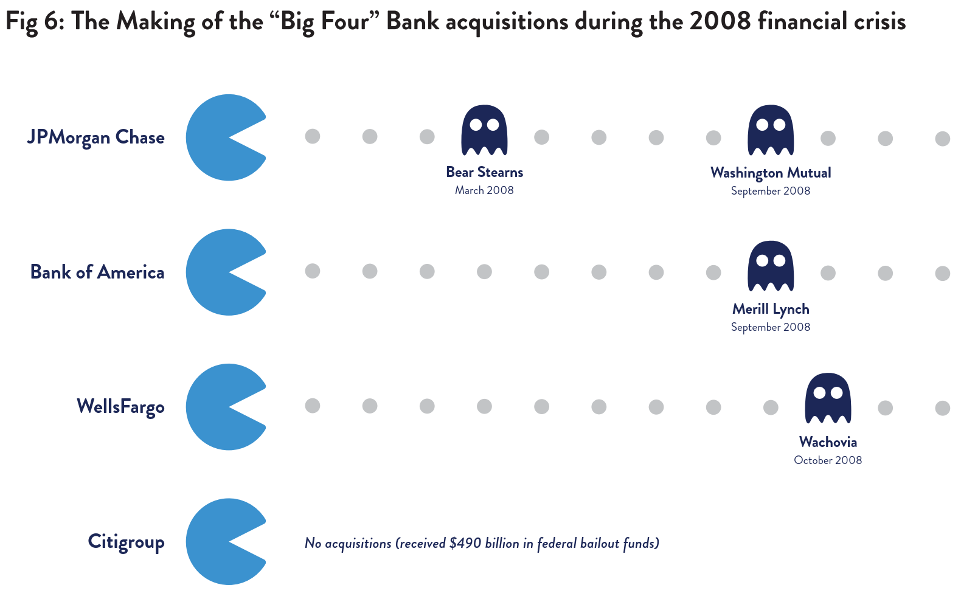
Only Citigroup, then the world’s third-largest bank, was too weighed down by its exposure to the subprime crisis to scoop up any of its smaller rivals. Instead, Citi received nearly half a trillion dollars in federal bailout funds, much of it with no strings attached.[94] This was not only more than any other bank received during the crisis, but also more than the amount spent on all pre-crisis federal bailouts combined. Today, JPMorgan Chase, Bank of America, Citi, and Wells Fargo are the four largest banks in the country and dominate U.S. commercial banking, with more than $9 trillion in assets between them.[95] The smallest of the four (Wells Fargo) holds nearly triple the assets of the fifth-largest bank.[96]
2009: The GM and Chrysler Bailouts
The U.S. auto industry had continued to decline in the decades following the 1979 Chrysler bailout. The shocks of 2007-2008 provided the coup de grâce for Chrysler and General Motors (similar to the impact of the September 11 attacks on the struggling airline industry). By late 2008, it was clear that both companies were on the brink of bankruptcy.
The debate over whether to bail out the automakers was heated. Auto manufacturers are not banks, and their failures would not cause businesses to lose access to the funds needed to make payroll or consumers to lose access to the money they need to pay bills. But, as in the 1970s, GM and Chrysler did employ hundreds of thousands of people, mostly in union jobs with pension plans that could be wiped out in traditional bankruptcy. The companies’ collapse also threatened to have a cascading impact on the rest of the auto industry, including parts suppliers, dealerships, and auto loan specialists.
The federal government therefore stepped in, first by providing the two corporations with $25 billion in bailout funds using their authority under the legislation that bailed out the financial sector during the 2008 crisis.[97] When Chrysler and GM continued to deteriorate, the government orchestrated pre-packaged Chapter 11 bankruptcies, providing loans to help sustain the companies’ operations while they restructured their debts. The combination of federal financing and pressure meant that the Chapter 11 process, which can take years for companies far smaller and less complex than Chrysler and GM, was completed in a matter of weeks. The two corporations ultimately received a total of $80 billion in federal bailout funds.[98]
2023: The Tech Bank Bailout
In his 2018 book Last Resort: The Financial Crisis and the Future of Bailouts, University of Chicago law professor Eric Posner lays out two paradigmatic examples of bank runs. The first type of bank run (call it a “depositor-led” bank run) starts with depositors. For example, say a local bank operated in a small town where the local factory had just closed. Due to their sudden loss of income, many of the bank’s depositors may be forced to draw down their savings quickly to pay their bills and meet other immediate needs. Knowing this, the other depositors may seek to withdraw their money as well out of fear that the bank will run out of money. That fear may become a self-fulfilling prophecy, since each withdrawal makes the bank’s inability to meet its obligations more likely, thus spurring still more depositors to withdraw their funds.
The second type of bank run (call it a “fear-of-failure” bank run) starts with fears surrounding the bank itself rather than its depositors. If a bank gets bad press or otherwise experiences something that shakes people’s confidence in it, depositors may withdraw their funds not because they need the cash right away, but because they fear the bank will go under and take their money with it. Once this panic starts, the remaining depositors start to withdraw their funds as well in a downward spiral similar to bank runs that start with distressed depositors.
Bank runs of both types have become much less common over time. Banks dependent on a small number of similarly situated depositors, like a factory town’s local bank, have become much rarer as people moved to larger metropolitan areas and local banks gave way to regional and eventually national and international banks. Moreover, the United States government insures all bank deposits up to $250,000 per account through the Federal Deposit Insurance Corporation (FDIC). That means that 99% of bank accounts are fully guaranteed by the federal government even if the bank that houses them fails.[99] Consequently, few depositors have any reason to fear they will lose their money even if they think their bank is about to go bust.
Leave it to the tech industry to make bank runs great again.
In 2023, four regional banks with close ties to Silicon Valley failed in rapid succession, falling prey to both types of bank runs. It started with Silvergate Bank, over 90% of whose deposits were linked to the cryptocurrency industry.[100] Silvergate was the primary bank for the fraudulent crypto exchange FTX, whose demise in late 2022 triggered a cryptocurrency collapse.[101] Crypto firms and their investors were forced to withdraw their money, leading to a depositor-led bank run. Silvergate failed on March 8, 2023.
Silvergate’s demise immediately triggered a run on Signature Bank, at the time a well-regarded regional bank with a reputation for scrappiness and providing services to overlooked neighborhoods and businesses — until, that is, it started soliciting crypto clients.[102] The crypto sector eventually became central to the bank’s business and reputation. Signature saw high outflows of depositors after the late 2022 crypto crash (another depositor-led bank run) that became a flood after Silvergate’s failure made depositors fear for the bank’s solvency (a fear-of-failure bank run).[103] The FDIC seized Signature Bank on March 12.
The other two failed banks, Silicon Valley Bank (SVB) and First Republic Bank, were based in the San Francisco Bay Area and focused on providing services to wealthy Silicon Valley clients. Both banks suffered from the same pair of flaws. First, they held billions of dollars in long-term bonds and mortgages that they had purchased when interest rates were low. This meant that, like the S&Ls in the 1970s, their balance sheets got weaker as interest rates rose. Second, the vast majority of both banks’ deposits were uninsured because they were above the $250,000 FDIC limit. Deposits above that limit are treated like any other debt in bankruptcy, which means depositors with seven-figure account balances would have ended up at best losing access to most of their funds for an extended time[104] and at worst losing their uninsured deposits altogether.[105]
These flaws combined to doom SVB and First Republic in the wake of the 2021-2022 inflation surge. As a result of the first flaw, the banks ran into trouble when the Fed started raising interest rates in 2022. As a result of the second, the banks’ wealthy clientele began withdrawing their funds once the banks’ fragility became known, leading to a fear-of-failure bank run.[106]
SVB was the first to fail. When the FDIC took over SVB on Friday, March 10, 2023, many of the bank’s wealthy Silicon Valley clients still had significant balances in SVB accounts. Over the following weekend, some of those clients began pressuring the Biden administration and Federal Reserve to guarantee all of SVB’s deposits without regard to the FDIC limit; “their rhetorical strategy of choice was to insist that unless SVB’s depositors were made immediately whole, the entire tech industry and every non-megabank in America would be at risk.”[107]
The regulators caved, agreeing on the evening of Sunday, March 12 to guarantee all SVB deposits, including those above the FDIC maximum.[108] This set the stage for another bank, First Citizens, to purchase SVB’s book of business at a discount two weeks later, with the FDIC absorbing an estimated $20 billion of SVB’s losses as part of the deal.[109] This was, in essence, a covert $20 billion bailout of the multimillionaire and billionaire venture capital and tech entrepreneurs who had millions of dollars each in uninsured SVB deposits.
Just as the collapse of Silvergate begat the run on Signature, the collapse of SVB triggered the run on First Republic. When First Republic failed seven weeks after SVB, its assets were sold to JPMorgan Chase, the largest U.S. bank — and the same bank that absorbed Bear Stearns and Washington Mutual during the 2008 financial crisis. Far from attempting to block a sale that made the country’s biggest bank even bigger, federal regulators (again) actively facilitated it.[110]
2025: Covert private equity bailout
In August 2025, President Trump issued an executive order directing regulators to relax the rules that protect workers’ 401(k)s and other retirement accounts from being sucked into opaque private markets.[111] The title of the order is “Democratizing Access to Alternative Assets for 401(k) Investors.” In other words, the administration framed the change as an investment opportunity for workers.
In reality, these changes are not intended to help workers, but rather to rescue private fund managers who, despite their immense wealth and economic power, are increasingly desperate to recruit new investors. As with the tech banks, albeit to a less extreme degree, many private equity and credit funds have underperformed since the Fed raised interest rates in 2022.[112] Fund managers cannot cash out investors in those existing funds, much less convince those investors to invest in new funds (including in the red-hot AI market) unless they can find new investors to pay off the old.
Indeed, the same week Trump issued his executive order, Bloomberg reported on private equity and credit firms’ rising use of so-called continuation vehicles (CVs), which are supposedly “new” funds but actually contain underperforming assets from one or more of a private capital firm’s existing funds.[113] Having put old fund wine into a new CV wineskin, the private capital firm recruits new investors to invest in the CV and then uses the proceeds to pay off the old fund’s investors. In some cases, the CVs have themselves underperformed, forcing fund managers to create CVs for CVs. I leave it to readers to decide for themselves just how closely this resembles a Ponzi scheme.
For now, the point is that the CV strategy only works as long as new investors can be recruited. That is why American workers’ retirement accounts are so attractive: they represent the largest untapped pool of potential new investors, with 70 million workers holding $12.5 trillion in retirement accounts.
In the months since the executive order, more and more cracks have appeared in the private capital ecosystem. A rising number of private capital firms have seen the equivalent of bank runs on their funds and have been forced to limit how much investors may withdraw to keep those funds from collapsing.[114]
The private equity industry had conducted a sustained lobbying campaign to push for regulatory changes that would open workers’ retirement accounts to them.[115] That the slow-motion crash in private capital markets came so soon after the executive order is strong evidence that the order was about plugging holes in private equity firms’ funds, not providing workers with investment opportunities. If the executive order is implemented and these firms’ shaky funds continue to stagnate or deteriorate, workers and retirees will increasingly be left holding the bag.
C. Bailout consequences: The big get bigger and the rich get richer
Readers will note a recurring theme in the above history: the government often allows, and in many cases actively encourages, large monopolistic and oligopolistic companies to take over struggling smaller ones. Indeed, such pairings increasingly seem to be the federal government’s first resort in a crisis, with regulators arranging them so quickly and eagerly that antitrust considerations — such as whether the elements of the failing-firm defense have been satisfied — appear not to enter the calculus. As Block wrote, such acquisitions are a form of covert bailout.[116] Worse, these shotgun marriages have generally not been accompanied by efforts to ensure that the mergers would not harm workers or consumers, much less by legal reforms to mitigate the need for future bailouts.
The core danger of monopoly is the power to exploit workers, businesses, and consumers and abuse political processes for corporations’ private ends. Previous Open Markets Institute publications have analyzed how monopolistic Big Tech companies are using their power to capture any new markets that AI unlocks and appropriate the gains for themselves.[117] The history of bailouts reveals the other side of that coin: when gains fail to materialize and an industry instead experiences a collapse or crash, powerful companies can still use their market power to entrench their dominance by ensuring that they benefit from any subsequent bailouts.
Another frequent consequence of bailouts is that the already wealthy executives of bailed-out corporations somehow end up still wealthier. Typically, bailouts (including the S&L, airline, and financial crisis bailouts discussed above) include some short-term restrictions on new executive compensation and golden parachutes — that is, huge severance packages that some executives receive when they are fired — as well as payments to shareholders like dividends and buybacks. But such legislation typically does not make the voiding of existing compensation agreements a condition of federal assistance.
For example, while the October 2008 financial sector bailout prohibited “any new employment contract with a senior executive officer that provides a golden parachute,” it allowed executives to collect any golden parachutes they had been granted under existing severance agreements.[118] GM CEO Rick Wagoner thus was able to walk away with a $20 million golden parachute in March 2009 after presiding over the demise of his company, which had previously accepted more than $17 billion in bailout funds and would file for bankruptcy two months later.[119] The 2001 airline bailout legislation was even more generous to executives, merely requiring that executives not receive pay increases for two years after receiving bailout funds.[120] Bailouts by the Federal Reserve often contain no meaningful restrictions, as exemplified by the more than $165 million in “retention bonuses” that AIG executives and financial services employees received just months after being bailed out.[121]
Because such payments often enrich people who played a role in the business failures and crises that necessitated the bailouts, they are particularly corrosive to public trust, creating the (not unjustified) perception that the goal of bailouts is to protect the interests of the wealthy and powerful rather than to benefit the economy as a whole. But these incidents of unjust enrichment tend to come to light only after public consciousness has moved on from the underlying crisis. As a result, the bursts of outrage have not yet translated into meaningful legislation to prevent the enrichment of bailed-out executives, much less the systemic changes that would be needed to prevent bailout conditions from arising in the first place.
D. Bailout justifications
As the above history illustrates, those seeking to obtain or justify a bailout usually offer two types of arguments:
(1) Importance: The firm or industry is important enough to warrant government action to preserve it. The most common variations of this justification are that the firm or industry is too big to fail or that its collapse would cause contagion through other parts of the economy. Either way, the implication is that the collapse would seriously harm ordinary people and the real economy.
(2) Worthiness: The firm or industry is worth preserving. The most common variations of this justification are that the firm or industry is fundamentally solvent and is simply facing temporary cash flow challenges and/or that it is the innocent victim of some unforeseeable event or circumstance.
1. Importance arguments
Bailouts are never cast as being primarily for the benefit of the bailed-out firms. Instead, proponents invariably frame each bailout as a necessary step to prevent severe negative consequences extending well beyond the bailout’s direct beneficiaries. The crux of a too-big-to-fail argument is that the bailed-out company or industry is systemically or strategically important, such that its failure would directly lead to severe consequences for the nation’s economy or security, even if its failure would not affect other companies or industries. The rescue of Lockheed in 1971 provides perhaps the purest example of this justification. The argument was not that Lockheed’s bankruptcy would cause an economic panic or lead to a cascading sequence of other ill effects. Rather, maintaining the nation’s largest defense contractor as a going concern was seen as essential to the country’s security in and of itself.
A contagion argument focuses not on — or at least not only on — the immediate consequences of a company or industry’s collapse, but on the possibility that such a collapse would start a chain reaction of other negative impacts. This argument is particularly potent in financial crises. The failure of a large bank poses systemic risk not just due to the sheer scale of its assets and liabilities but also because large banks constantly do business with many other financial institutions. As a result, banks tend to hold lots of other banks’ assets at any given time. Because assets are frozen in bankruptcy, it’s not just the bank’s clients that may lose access to their assets when a bank fails, but the clients of any other financial institutions that had the misfortune of doing business with it.
Too-big-to-fail and contagion arguments are often closely linked. The larger the bank, the more interconnected it typically is with other banks, which means that bigger banks both are more important in themselves and create bigger risks of contagion. Proponents of the 2009 auto industry bailouts also leaned on both types of arguments. Chrysler and GM employed hundreds of thousands of workers and supported the economies of a number of cities and towns (too big to fail) and there was a risk that their failures would spark an even larger auto industry meltdown (contagion).
That said, the history of bailouts demonstrates that those seeking bailouts often advance arguments that lie somewhere between dubious and absurd. Consider the 2023 tech bank meltdown. SVB and the other tech-linked banks that failed with it in the spring of 2023 clearly were not too big to fail. True, the SVB and First Republic bank failures were the largest since the 2008 financial crisis. But collectively, the four failed banks had a market share of just 2.5% among U.S. commercial banks, and their combined assets were less than one-quarter of Wells Fargo’s, the smallest of the Big Four.[122]
The tech bank failures also posed no real risk of contagion. Financial sector contagion typically arises when large numbers of interconnected institutions have large holdings of the same toxic assets. That was the case during the S&L and subprime mortgage crises, but not during the tech-oriented bank failures of 2023. Unlike Silvergate and Signature, few banks were dependent on business from crypto companies.[123] The vast majority of banks also did not have business models based, like SVB’s and First Republic’s, on interest rates remaining perpetually near zero or balance sheets that depend on a small number of ultra-rich clients parking huge amounts of uninsured deposits with them. Nearly 90% of SVB’s deposits were above the FDIC limit at the time of its failure, double the national average in 2022.[124]
The tech banks were notable primarily because of the wealth and political influence of their clients. It was that power and influence, not any realistic chance that their failures would affect the broader economy, that led to the bailout of SVB’s tech millionaires and billionaires.
2. Worthiness arguments
Turning to the other category of bailout justifications, one common worthiness argument is that the bailed-out business is fundamentally sound (or solvent) but is temporarily short on cash (or illiquid). The distinction between rescuing a firm that is illiquid and one that is insolvent is akin to that between attempting to bail out a ship that can be repaired and one that will sink regardless.
Solvency arguments are important for reasons of both fiscal prudence and democratic accountability. From a financial perspective, the government should be able to structure a bailout of a solvent firm in a way that allows taxpayers to (eventually) get their money back. That allows the intervention to be spun as less a bailout than an investment. Conversely, bailing out a firm that is insolvent, and thus likely to fail anyway, wastes taxpayer funds and makes the assistance look less like a bailout and more like good old-fashioned corporate welfare.
Another common type of worthiness argument asserts that the bailed-out company is an innocent victim of some unforeseeable external event or circumstance. These innocence arguments are particularly important when the bailout includes no-strings-attached grants of money to the bailed-out firm or its creditors and shareholders.
An archetype for an “innocence” argument would be the Paycheck Protection Program (PPP) passed in the aftermath of COVID, which allowed virtually all small businesses to stay afloat during the peak of the pandemic as long as they did not lay off their workers. The recipients of PPP funds neither caused nor could have reasonably foreseen the pandemic. Additionally, most had good solvency arguments — although no one knew how long the crisis would last, it was correctly assumed that most businesses would eventually recover once it ended.
Worthiness arguments are also often quite weak. Companies seeking bailouts frequently attempt to blur the already hard-to-discern line between insolvency and illiquidity, attempting to make their critically damaged ships seem seaworthy. Many do so by framing the crisis that threatens to drive them into bankruptcy as a transient event that makes their assets appear less valuable than they actually are. Thus, such companies argue, they will eventually recover and be profitable again as long as they get government assistance.
Using this logic, numerous financial institutions requested and received bailout funds during the 2008 financial crisis even though their assets were worth far less than their liabilities on the open market, with no guarantee of when or if they would recover. Up to and even past the bitter end, many executives and shareholders of Bear Stearns and Lehman Brothers refused to accept that their firms were insolvent. Each claimed that they were the victims of short sellers (investors who identify overpriced companies and bet that their stock will go down) and that their assets would eventually rebound in value once the market panic subsided.[125]
Remarkably, despite being deeply involved in the reckless, opaque practices that gave rise to the crisis, they also proclaimed their innocence. In addition to blaming short sellers, financial firms pointed to risk models that they had developed to argue that the nationwide decline in housing prices that followed the collapse of the subprime market had been an unforeseeable event.[126] But the models’ failure was quite foreseeable. Most of the models only went back a few years, far less than the term of a typical fixed-rate mortgage and not long enough to capture any serious financial crisis.[127] The firms that deployed them ignored both the historical fact that housing prices had declined nationally in earlier historical periods and the common-sense economic principle that no asset is likely to increase in value forever.[128]
The 2023 bailout of Silicon Valley Bank’s wealthy depositors again provides an example of a bailout that occurred despite any plausible worthiness arguments. SVB clearly was insolvent, having already been seized by the FDIC at the time regulators decided to guarantee all the bank’s deposits. At that point, there was not even a boat left to salvage, rendering the guarantee a giveaway that benefited only a handful of wealthy depositors with account balances above $250,000, a level that meant that their bank accounts contained more than double the median American’s net worth.[129]
Moreover, the Silicon Valley executives and venture capitalists whose wealth was rescued by the covert bailout played a key role in accelerating SVB’s failure. Venture capital industry newsletters, emails, and social media posts during the run-up to SVB’s collapse fueled speculation about SVB’s imminent failure, making its rapid and chaotic collapse something of a self-fulfilling prophecy.[130] Researchers concluded that this likely accelerated SVB’s demise.[131]
Nevertheless, SVB’s wealthy clients had political cachet and were able to scare federal officials into believing that the stability of the financial system depended on bailing them out. That raises a disturbing question: If tech billionaires were so easily able to obtain a bailout of their preferred bank, what could they convince policymakers to do if the entire tech sector faced collapse?
Part III: Rebutting (and Prebutting) the AI Industry’s Bailout Arguments
Having reviewed the ingredients for an AI downturn and the nature and history of bailouts, it is time to turn to the question of what bailout arguments we can expect tech companies to make if, or rather when, a significant AI downturn arrives. We need not speculate as to some of these arguments because a stealth AI bailout movement may already be underway, as suggested by the quotes from David Sacks and Sarah Friar in the introduction to this report.[132]
This section is organized around the two categories of bailout justifications laid out above, starting with importance arguments before turning to worthiness arguments. I have included both the arguments that AI industry insiders most commonly advance today when pushing their policy goals as well as the strongest arguments that I think they could make once a downturn hits. All of the potential arguments are weak, some because they are based on faulty premises, others because the premises do not support the conclusion that a bailout would be necessary or appropriate.
A. Importance arguments
1. “We need to beat China”
Big Tech and venture capitalists have long leaned on superpower rivalry-based rhetoric to advance their policy objectives, particularly stifling any efforts by policymakers to hold tech companies accountable for AI-related harms. When Senator Ted Cruz attempted to advance legislation that would have banned states from regulating AI, he justified it by arguing: “As a matter of economic and national security, America has to beat China in the AI race.”[133] When President Trump signed a similarly themed executive order, he argued that unless states are prevented from regulating AI, “China will easily catch us in the AI race.”[134]
This strategic importance argument evokes the nuclear arms and space races that defined the United States’s last superpower rivalry. When the AI bubble bursts, Big Tech thus will no doubt lean into the “race with China” rhetoric again, arguing that the government should spend whatever it takes to preserve the industry. Chinese competition no doubt poses a threat to the business interests of U.S.-based tech companies, but does Chinese investment in AI pose a threat to Americans more generally?
The first line of the executive order attempting to ban state AI regulation hints at the two variations of the “we need to beat China” argument, stating that U.S. leadership in AI “will promote United States national and economic security and dominance.”[135] Thus, the first variation of this argument is that staying ahead of China on AI is essential to U.S. national security; the second is that the race is about economic dominance.
National security arguments
The first line of argument boils down to AI being essential to the U.S.’s present and/or future national security. As such, they will argue, a bailout would be needed to preserve national security if the AI industry faces a crash.
This argument relies in part on the slipperiness of the term “AI,” which can encompass a wide range of technologies that have little in common aside from the fact that they involve the processing of data by computers. Many technologies falling under that broad umbrella, such as computer vision and predictive analytics, do have real, valuable national security applications. However, the huge sums of money that tech companies are spending on chips, data center construction, energy, and other AI-related investments are not focused on those types of AI. Instead, AI investments are overwhelmingly going towards training and running generative AI systems built on the same basic architecture as ChatGPT. As a result, the issue is not the strategic importance of AI generically, but the strategic importance of chatbots, image generators, and related forms of generative AI.
On that front, there is ample evidence that generative AI systems are simply too prone to errors to be relied upon in life-or-death situations. In 2023 and 2024, Pentagon-sponsored hackathons ran into the same LLM biases and errors, or what are often called “hallucinations,” that plague consumer-facing chatbots.[136] The U.S. Navy then published guidance cautioning against the use of LLMs due to security vulnerabilities and the risk of inadvertent release of sensitive information.[137]
Perhaps the more sophisticated “agentic” AI systems introduced since 2025 changed this equation? Not at all. In fact, such systems only increase the risks posed by simpler generative AI systems. In a recent paper, military strategists from the U.S. Army War College published their insights from extensive wargaming experiments involving generative AI systems, including agentic systems. They concluded that “an increasing reliance upon agentic systems in military planning, particularly at the strategic level, gives the Army a glass jaw” because human commanders over-rely on algorithmic outputs that often are critically flawed.[138]
These pitfalls should come as no surprise. Generative AI systems tend to break down when attempting to perform even moderately complex tasks.[139] Moreover, a long history of psychological research shows that people tend to trust automated outputs even when such trust is unwarranted and especially when it reinforces existing beliefs.[140] That is, to put it mildly, not a good mix when the stakes are high, such as in military and intelligence settings.
As this report goes to press, generative AI appears to have come into increasing military use in the Iran War. The military’s use of Palantir’s Maven Smart System, which uses Anthropic’s Claude LLM to rank targets, may have played a role in the bombing of a Tehran girls’ school that killed 168 people.[141] We may be learning the hard way that LLMs are far too unreliable to be relied upon when lives and security are stake.
To the extent there are potentially valuable military applications of generative AI, that is an argument for targeted research funding through well-established institutions subject to regulatory oversight such as the Defense Advanced Research Projects Agency (DARPA). It is not an argument for subsidizing the AI (or rather the chatbot) industry, much less bailing it out if corporations are unable to find enough productive uses for generative AI products and services to make the industry profitable.
Economic arguments
The other sections of this part cover economic arguments, but one argument in particular bears mentioning here. This argument posits that if the AI industry crashes, China will take the “lead” in AI, causing other countries (and perhaps even Americans) to become dependent on Chinese AI.[142] As with national security, however, the economic evidence provides little reason to think that LLM dominance is essential to our economic future. As previously noted, the AI industry is wildly unprofitable, with no clear path into the black. At both the level of individual businesses[143] and of the economy as a whole,[144] there is no evidence that generative AI is boosting productivity. As discussed in the next section, there is no indication that it is bringing other real economic benefits either. Being the world leader in LLMs is not a prize that is worth the cost of a bailout.
2. “AI is too big to fail”
David Sacks’s statement that a reversal in the AI investment boom “would risk recession” teased the argument that the AI industry is too big to fail. Certainly, Sacks is correct that the AI industry is big, as the AI-fueled stock market dominance of Big Tech demonstrates. But more recent data suggests that AI added little, if anything, to GDP in 2025.[145]
Moreover, the AI industry’s huge valuations and spending have come by way of the industry leveraging its market power to grab resources from other parts of the economy. The data center boom has consumed huge quantities of vital resources, including energy, water, construction materials, and memory chips[146] (to say nothing of the copyrighted materials that AI companies pirated to train generative AI systems).[147] This has led to significant price and utility rate increases in areas where AI data centers operate and, in some cases, across the country.[148] Nobel Prize-winning economist Daron Acemoglu notes that the tech giants at the center of the AI industry are “overwhelmingly focused on replacing workers rather than complementing them,”[149] which may help explain the lack of detectable productivity increases from AI.[150]
As a result, consumers, workers, and businesses outside the tech sector have not benefited from the AI boom. Between the start of 2021 and the end of 2025, the valuations of the eight largest tech companies more than tripled while real wages for American workers fell slightly.[151] In 2025 alone, the biggest tech companies saw their valuations surge by over 20% while low-wage workers experienced a 0.3% decline in their spending power.[152]
The stagnation of the non-AI economy in the midst of the AI boom suggests not that the AI industry is too big to fail, but rather that it is simply too big.
As noted above, AI companies claim to be earning tens of billions of dollars in AI-related revenue, but even assuming those numbers are accurate, they are spending trillions of dollars to do so. If those unprecedented investments fail to produce a return, that would be a strong signal that AI is not a sustainable source of growth even for AI companies themselves.
A recession usually follows a bubble bursting, as the dot-com and subprime bubbles illustrate. The size of the AI bubble makes such a recession a particularly strong possibility, but that would be the inevitable consequence of bringing an end to the unbalanced, unsustainable, and ultimately illusory gains that a bubble brings. An AI bailout would certainly benefit AI companies, but at the expense of prolonging an economic cycle that has not been kind to the rest of the economy.
3. “Bailing out the AI industry will contain the crash”
The “contagion” argument most commonly arises, and is most compelling, in the financial sector. This is because institutions like banks, private equity funds, and insurance companies both have custody of many people’s and businesses’ funds and are deeply interconnected with countless other financial institutions. As a result, the failure of a single large financial institution can send tremors throughout global financial markets, as the collapse of Lehman Brothers did in 2008.
The risk of contagion is greatly diminished for firms, even financial institutions, outside the largest banks. Nevertheless, the pressure campaign that led to the bailout of SVB showed that tech industry insiders are more than willing to make contagion arguments, however dubious, to protect their financial interests. Their argument for bailing out their own industry in the wake of an AI downturn might proceed as follows:
The scale of investment in AI development and supporting infrastructure is unprecedented, sucking in funds from all corners of both equity and debt markets. Private equity firms and other parts of the shadow banking sector are particularly deeply invested in AI and would be heavily exposed to any downturn. The commercial banking sector that provides basic financial services to individuals and businesses is, in turn, closely tied to the shadow banks (just as it was in the run-up to the last financial crisis). Consequently, a deep enough AI downturn could destabilize the financial system.
Once a crisis reaches such an advanced stage, it is very difficult and very expensive to contain. One can imagine a financial crisis as resembling a complicated formation of dominoes, where a single domino knocks down two dominoes, each of which knocks down two more dominoes in turn, and so on, such that the first fallen domino creates a chain reaction that ultimately can cause hundreds or thousands to fall. It is far easier to stop this chain reaction before it starts than to wait until the dominoes start falling.
Applying the same logic to a financial crisis, the best way to stop contagion is to keep the first dominoes (here, the tech companies and related entities raising and spending money on the AI boom) from falling in the first place.
This logic may seem attractive on the surface, and it holds up until the last two sentences. But there it falls apart.
First, it assumes incorrectly that stopping a chain reaction requires propping dominoes up rather than preventing them from knocking other ones over. But the latter approach is just as effective. The federal bankruptcy process takes the “allow companies to fail safely” approach by ensuring that insolvent companies can be restructured or dissolved in an orderly manner while preserving as much of the value of their assets as possible. That bankruptcy process is challenging to perform with large banks. Owing to the sheer scale of assets banks control and their interconnectedness, financial markets may freeze up if a big bank’s assets are tied up in bankruptcy courts for months or years.

But tech companies are not banks. None of the Magnificent Seven, the neoclouds, or AI startups hold the money that consumers use to pay bills, lend money to small businesses, or hold billions of dollars of each other’s liquid assets. There simply is no reason a tech company, even a historically large one, cannot go through the usual bankruptcy process.
Second, bailouts are not the only or even the best way to stop financial sector dominoes from falling in the wake of an AI crash. The argument for bailing out tech companies in such a crash assumes that to stop contagion, someone has to be bailed out, and it’s better for the bailout to be cheap and early than expensive and late. But that is a false choice. Even in a financial panic, there are better options for stopping a financial crisis from spiraling than bailing out companies that make or receive ill-advised loans or investments. The question has always been whether policymakers have the resolve necessary to adopt and implement them.
The Dodd-Frank reforms, passed in the aftermath of the last financial crisis, were explicitly designed “to end ‘too big to fail’” and “protect the American taxpayer by ending bailouts.”[153] However, the bill was weakened significantly even before its passage, and matters have only gotten worse since. Enforcement has proven exceptionally vulnerable to industry influence, and both Trump administrations have significantly curtailed the law.[154]
There is an urgent need for an improved version of Dodd-Frank that either requires systemically important financial institutions to break up or have bulletproof balance sheets while providing faster and more robust resolution mechanisms for failing institutions. For example, economists from across the political spectrum have endorsed the idea of allowing for “speed bankruptcy” when financial institutions fail during a crisis. Under this paradigm, ownership of an insolvent firm would immediately transfer from its shareholders to its creditors rather than going through the lengthy process of FDIC receivership or Chapter 11 reorganization.[155] Such reforms would give markets confidence that systemically important financial institutions will not chaotically collapse and that the basic plumbing of the financial system will continue functioning in a crisis, even as some companies go bankrupt.
Relatedly, the AI industry may argue that a bailout is needed to protect the jobs of workers and the solvency of businesses in adjacent sectors, similar to the arguments that drove the auto and airline industry bailouts. The argument here would be that allowing major AI companies to collapse would destroy not only the jobs of their own employees, but also the jobs of people in industries that have sprung up to support it, such as construction workers who build data centers. Even leaving aside the questionable wisdom of the auto and airline bailouts, however, these arguments are not tenable for the AI industry.
At the time of the auto industry bailout, GM and Chrysler directly employed hundreds of thousands of people, mostly in unionized jobs. While Nvidia and Alphabet are the two most valuable companies in history, they have fewer employees combined today (approximately 230,000) than General Motors did in 2008 (242,000).[156] Other companies in the AI ecosystem are even smaller. OpenAI employs roughly 4,000 people and CoreWeave (the largest neocloud) just 2,200, less than some individual automobile manufacturing plants.[157] While Amazon is the second-largest private employer in the country, the vast majority of its employees are in its e-commerce and logistics divisions, which could easily be spun off or sold off in bankruptcy if needed without resorting to a bailout.
Airlines are also much more labor-intensive than tech companies, as are many industries that depend on air travel, such as hotels, taxis, and so forth. The biggest distinction between the airline industry after September 11 and the AI industry lies in the relative strength (or, rather, lack of weakness) in their worthiness arguments, which are discussed further below.
4. “The digital economy depends on the cloud, and the cloud is now too interwoven with AI to let the industry collapse”
In July 2024, an erroneous update to Microsoft’s Windows operating system from cybersecurity firm CrowdStrike triggered the largest IT outage in history, paralyzing some 8.5 million computers dependent on Microsoft’s operating system and cloud computing infrastructure for hours and in some cases days or weeks. This massively affected major businesses, airports, courts, governments and public healthcare systems. Former Federal Trade Commission Chair Lina Khan argued that this unparalleled crash revealed “how concentration can create fragile systems”.[158]
The above excerpt from Open Markets Institute’s 2025 report, Engineering the Cloud Commons, illustrates both how cloud service disruptions can have ripple effects throughout the economy and how the concentration of cloud services in the hands of a few giants increases systemic risk. Today, AI-related services take up a large and rapidly expanding share of traffic for the three dominant cloud-service providers (Amazon Web Services, Microsoft Azure, and Google Cloud), while dominating the share of services for AI-first “neocloud” companies like CoreWeave and Nebius. Oracle, the fourth largest cloud service provider, is likewise increasingly pivoting to building out AI cloud infrastructure. The strain this has placed on cloud infrastructure is one of the key factors driving the enormous spending on new data center construction.
It is tempting to think that a crash in the AI market might actually improve web service quality and reliability by freeing up capacity for non-AI traffic. But the more likely outcome would be further consolidation and service degradation. The neoclouds and other smaller cloud service providers (including Oracle) would be among the first to teeter in an AI downturn. The cloud giants, buttressed by the revenues from their non-AI business lines, will no doubt try to swoop in and scoop them up, asking antitrust regulators and courts to provide a covert bailout by closing their eyes to the harm to competition that would follow such consolidation.
The tech giants will likely offer the usual justifications, arguing that allowing the cloud giants to take over their smaller rivals would allow for greater economies of scale and other efficiencies. One of the “efficiencies” that typically accompanies such corporate takeovers is significant layoffs. On average, roughly 30% of employees are deemed redundant in the wake of mergers or acquisitions involving two companies in the same industry.[159] As I observed during my time practicing employment law, the first workers on the chopping block after such deals close are non-revenue-generating support staff — such as the engineers, programmers, and technicians who push updates, spot bugs, and otherwise keep cloud services operating smoothly. Allowing the cloud giants to grow even further thus would harm competition while quite likely increasing the risk of service degradation.
The better solution, as set forth in greater detail in Engineering the Cloud Commons, is to remove this critical digital infrastructure from monopolistic control altogether and treat cloud services as a utility. As that report explains, as “the digital backbone of the modern economy,” cloud infrastructure is fundamentally similar to other key public utilities, such as telecoms, transportation, and energy. The concentration of that infrastructure in the hands of a few huge, unaccountable tech giants already poses significant risks, since those tech giants have strong incentives to give preferential cloud access to their own services but little incentive to compete on quality due to the lack of competition. An AI crash would strengthen the case for separating ownership of cloud infrastructure and AI technologies, as called for in the Cloud Commons report, because it would provide solid evidence of how such common ownership infects essential cloud infrastructure with greater financial fragility and risks. Allowing further consolidation in the wake of a crisis would only exacerbate those risks.
5. “An AI crash would stifle innovation”
AI bailout requests will likely be accompanied by assertions that allowing the AI industry to crash would devastate innovation. This would be a variation on an argument advanced in almost comically hyperbolic terms during the collapse of SVB, during which tech industry boosters claimed that the bank’s failure would “alter[] the very course of American innovation”[160] or “be an existential risk to competition and innovation in the American economy for the next decade.”[161] But the idea that American innovation is dependent on tech companies is Silicon Valley conceit, not economic reality.
True, the architecture that underpins today’s generative AI systems (the transformer, the “T” in GPT) was first described by Google researchers.[162] But the foundational breakthroughs in neural networks — the general class of AI technologies to which all of today’s generative AI systems belong — came decades before from academic researchers at public universities, such as Alexey Ivakhnenko (Soviet Institute of Cybernetics), Shun’ichi Amari (Kyushu University), and David Rumelhart (UC San Diego). In fact, the most significant contribution to the underlying technology from corporate America came from Yann LeCun and other researchers at Bell Labs, an institution that was required by federal antitrust enforcers to license its patents and take other steps to ensure its research benefitted the public.[163]
More generally, Big Tech and venture capital firms are primarily building their products on foundations laid by government-supported and public interest researchers. Venture capitalists and for-profit corporations played little role in the creation of the modern Internet, which started with a network developed by federal defense researchers at DARPA and was built out into the World Wide Web by Tim Berners-Lee, a researcher at the intergovernmental research institute CERN. Google co-founders Larry Page and Sergey Brin developed the search algorithm that made them rich at the Stanford Integrated Digital Library Project, which was part of the federal Digital Library Initiative through funding from the National Science Foundation.[164] Silicon Valley can claim some key innovations, particularly in electrical engineering and software development, but it is far easier to identify major Information Age innovations made by public sector and nonprofit research institutions with little contribution from industry than vice versa.
Where Silicon Valley has truly shined is in the arts of cornering markets and exploiting workers and consumers. The tech industry’s most commercially successful “innovations” in recent years have increasingly involved invasive tracking, rent-seeking, and exploiting psychological weaknesses to addict consumers to their products and services.[165] These tendencies appear only to be accelerating as the tech industry becomes increasingly fixated on AI.[166]
In fact, the biggest barriers to technological innovation in recent years have been the anti-competitive business practices of Big Tech — such as acquiring potential competitors or using platform monopolies to stamp them out[167] — and venture capitalists’ focus on cultivating startups that have the potential to build similarly monopolistic businesses.[168] Silver linings will be hard to find in the aftermath of an AI crash, but the potential for a more dynamic and less extractive innovation ecosystem is one.
B. Worthiness arguments
1. “It’s not even a bailout; it’s an investment”
AI companies may be losing money hand over fist on generative AI, but they are far from insolvent. In fact, their ranks currently include the most valuable public and private companies in history. There thus is a high risk that AI companies will attempt the same maneuver that private equity firms — which, relatedly, are deeply invested as both shareholders and lenders in AI companies — performed last August (see Part II.B).
As long as AI companies enjoy sky-high valuations, they will be able to depict any requests for loan guarantees, tax relief, equity infusions, or other government assistance as investments or even partnerships rather than bailouts. That makes such veiled bailout requests especially insidious. Public sector support for the private sector’s development of a technology might[169] make sense if the technology does not attract sufficient private sector investment.[170] That is most certainly not true of AI, however. The AI infrastructure explosion has already drawn greater private sector investment in a shorter period of time than any industry in history, attracting more investment dollars than even landmark publicly financed projects like the Manhattan Project that built the atomic bomb, the Apollo moon landing program, and the Interstate Highway System.[171]
The corporations driving this boom have shown no desire before to let taxpayers share in any profits they hope, however implausibly, they will get from AI products and services. On the contrary, they have sought and received extensive taxpayer support through tax credits and other incentives,[172] with Amazon, Alphabet, Meta, and Tesla receiving a combined $51 billion in federal tax breaks in 2025 alone.[173] Be wary of any “investment” opportunities they offer taxpayers now.
2. “We’re not broke — prosperity is just around the corner”
Tech and venture capital executives will undoubtedly argue when an AI crash begins that the downturn is only temporary and that their firms are solvent. The gist of the argument will likely be:
AI really is a transformative technology, but we got the timing wrong on how quickly the AI revolution will happen. Yes, we got overexcited by spending trillions of dollars on data centers despite only generating a fraction of the revenues needed to cover those expenses, but those revenues will eventually materialize. Bail us out so we can keep our work going, and our assets will soon be worth more than our liabilities.
This argument both (1) ignores the availability of bankruptcy protection to address most liquidity issues and (2) attempts to erase the distinction between liquidity and solvency.
On the former point, there is a simple remedy available to companies that are solvent but facing severe cash flow problems: they can file for Chapter 11 bankruptcy protection. Chapter 11 allows companies to protect their assets from creditors so that they can restructure their debts and preserve the underlying business. The lengthy Chapter 11 reorganization process is impractical for banks; freezing a large bank’s assets would mean tens or even hundreds of billions of dollars in deposits and other assets belonging to third parties being inaccessible for months or years. But tech companies are not banks, and the Chapter 11 process would be an adequate remedy for tech companies facing a liquidity crisis.
Moreover, and as was the case with Bear Stearns’s and Lehman’s solvency arguments, this argument attempts to eliminate the distinction between solvency and liquidity by framing a company as solvent so long as it can argue that its assets will eventually be worth more than its liabilities. It is true that many assets do increase in value over time and are particularly likely to do so after an economic panic, during which even perfectly good assets often lose value. But it does not follow that a company is nevertheless solvent when its assets plummet in value, and that argument is especially shaky in the context of AI.
First, in the words of Yogi Berra, “it’s tough to make predictions, especially about the future.” Because no one can predict whether or when companies will achieve or return to profitability after a serious downturn, a “solvency” argument based on the eventual recovery or appreciation of asset values is inherently flimsy. This is particularly true of assets or companies caught up in a bubble, and even truer when that bubble is centered on a technology whose profit potential is unproven. The speculative nature of bubbles means that it is impossible to pin down the “fundamental” values of companies or assets caught up in them. Amazon, Oracle, and Microsoft survived the bursting of the dot-com bubble, but WebVan, Pets.com, and many others did not. Bubble survivors may take years or even decades to recover their pre-bubble value.[174]
To that point, it took the Federal Reserve more than a decade to sell off the toxic Bear Stearns assets, and the “profit” it made on them was equivalent to a rate of return of approximately 1% per year — less than the rate of inflation during that decade. Defenders of the Bear Stearns bailout claim that the Federal Reserve was eventually able to resell the investment bank’s assets for a profit, but in terms of real dollars, the Fed lost money on its investment. In any event, a “liquidity” problem that takes more than a decade to overcome is really a matter of solvency.
Moreover, and as previously noted, AI has thus far not only failed to prove its economic value; it has been a money incinerator. Today, the argument that AI services will eventually generate enough revenue to cover the enormous cost of building and operating them is highly speculative. If there is a crash, confidence in the long-run profit potential for the industry should decrease rather than increase.
This is especially true given the very short shelf life of the key assets at the center of the AI boom, namely graphics processing units (GPUs), the chips that are used to train and run AI models. Railroad tracks and fiber-optic cables have a useful life of many decades. The physical lifespan of AI GPUs is less than one decade — much less when they are used at full capacity.[175] Moreover, Nvidia and its competitors are constantly designing new chips and placing them in the production queue, and older chips quickly lose their value as these new chips hit the market. With the physical assets at the center of the AI boom constantly declining in value, new bailouts might be needed again in just a few years to keep the industry going — and, even then, there would be no guarantee that companies will be able to turn a profit on generative AI.
When considering whether government assistance for a shaky enterprise is appropriate, any solvency analysis should be based on what the company could get for its assets on the open market today, not on the industry’s rose-tinted view of what it could theoretically be worth in the future.
3. Some potential innocence arguments
Every bailout recipient makes at least a superficial appeal to innocence, claiming that they were the victim of some unforeseeable circumstance even if they were at the epicenter of the underlying crisis. It may seem inconceivable that the tech executives who inflated the AI bubble with hype and suspect accounting practices would nevertheless argue that they did not cause and could not have foreseen the bursting of the bubble. But they undoubtedly will do exactly that — just as bank executives did during the 2008 crisis.
What might such innocence arguments look like for the AI industry? To answer this, one need only look at who and what AI boosters are blaming for the industry’s current trouble spots: the data center construction bottleneck, regulators, public opposition, foreign competitors, and their own corporate clients’ struggles to incorporate AI into their operations. But the appearance of each of these obstacles was quite foreseeable and, in most cases, was due in large part to the AI industry’s own actions.
The ongoing data center construction bottleneck (set to get larger as public outrage over data centers’ community impacts grows) can hardly be characterized as unforeseeable or even external to the tech industry. Ensuring that you have an accurate sense of whether and when you will have the necessary labor and resources is Project Finance 101, regardless of whether a company is doing the project itself, through a shell company, or through third-party contractors.
Tech lobbyists and allied corporate front groups will likely blame regulators and public opposition both for data center delays and for any underperformance of AI companies relative to their unrealistic revenue projections. Indeed, these groups are already attempting to scapegoat state and local governments for the delays in data center construction,[176] even though community opposition is eminently foreseeable for projects that are straining communities’ energy and water resources.[177] AI data centers are having significant impacts on the cost of living and quality of life in the communities in which they operate.[178] The AI industry itself has contributed to public mistrust by claiming, however dubiously, that AI could threaten tens of millions of jobs in the coming years. Public skepticism is a reasonable and rational response, not a justification for a bailout.
Foreign competitors, particularly Chinese AI firms, are another likely scapegoat. But the rise of competitors, foreign and domestic, is hardly surprising. Also, the relative success of Chinese AI is in part because many Chinese models, like DeepSeek, are open source, meaning that developers and businesses can use them to build AI products and services without paying a license fee. LLM developers in the U.S. have made their leading models proprietary (including OpenAI, despite the company’s name).[179] They may come to regret that decision, but regrettable is not the same as unforeseeable.
Finally, AI companies will likely try to blame their own clients if profits fail to materialize, claiming that companies simply are not integrating or using AI properly. Expect that excuse to pop up even if it becomes evident — or, rather, if it continues to be evident[180] — that there simply is no way to integrate generative AI systems into most workflows in a way that adds value.
Regardless of the chosen scapegoats, policymakers should reject any AI industry efforts to deflect blame for a crash to external parties or events. As stated at the beginning of this report, the AI industry has systematically inflated expectations about the transformational potential of the technology as well as the speed at which the AI revolution will unfold. Those who purposefully cultivate unrealistic expectations can hardly point the finger at others when those expectations prove impossible to realize.
Likewise, questionable accounting practices that inflate profit and hide debt have become endemic in the AI industry, as discussed at the end of Part I. Those machinations have historically been signs of companies in distress. It is unlikely that AI companies’ executives and lenders are unaware of the risk their bets will not pay off.
4. The “lucky recession” scenario: What if something else wrecks the economy first?
So far, the unspoken assumption has been that the bursting of the AI bubble will not be precipitated by some economic crisis primarily originating outside of the AI industry. Of course, it is more than possible that another brewing trouble spot in the global economy — such as the Iran War, tariffs, de-dollarization, or a crypto crash — gets there first. If the bubble bursts as the result of some such external shock, it could be fortunate for the AI industry, which would be able make a more credible innocence argument because it could point to events beyond its control as an immediate cause of its demise.
Consequently, a “lucky recession” would create an especially high risk of AI companies receiving an undeserved bailout. Sympathetic policymakers might frame public assistance as a bridge loan or “investment” designed to sustain the industry that, in their minds, presents the best hope of generating an economic turnaround. Similarly, a disguised bailout might be presented as a form of stimulus if a broader economic downturn threatens the industry.
I saved this scenario for last because the response to such arguments should by now be apparent: even if the AI industry had a believable innocence argument, there are numerous other reasons that the industry is neither important enough to warrant a bailout nor worthy of one. AI companies are not strategically or systemically important. They are fundamentally unlike financial institutions and do not present a real risk of contagion. Their hype has inflated the bubble, and their dubious accounting methods have sustained it. An external recession would change none of that, nor would it alter the basic fact that AI companies are losing stunning amounts of money despite years of sustained hype.
The 2001 airline bailouts serve as a useful reference point. In the aftermath of the 9/11 attacks, airlines had seemingly strong bailout arguments. In terms of importance, air travel had been woven into the fabric of the United States economy and society for decades and its collapse would have ground business in many other sectors, including tourism and hotels, to a screeching halt. In terms of worthiness, while legacy carriers had been struggling for years, most probably could have muddled through; certainly, they hadn’t been hemorrhaging money like generative AI companies are. The 9/11 attacks were also the textbook example of a sudden, unforeseeable event originating outside the stricken industry. By contrast, the surge in debt to finance the AI boom didn’t begin in earnest until late 2025, after the beginning of the tariff wars and the first set of U.S./Israeli strikes on Iran in June of that year.[181]
And still, the effort to bail out the airlines largely failed. After burning through their bailout funds, the industry resumed its steady decline. Over the following several years, nearly every major airline (Southwest being the most notable exception) either went bankrupt, sold itself to a larger rival to avoid bankruptcy, or both.
AI industry lobbyists will undoubtedly come asking for assistance if economic clouds appear on the horizon because they know their shaky ships are unable to weather a storm. But there is a fundamental difference between an economic shock that creates an industry’s fragility and one that merely exposes it. The AI industry’s weakness is already apparent. Policymakers must recognize this and reject future bailout requests, whether explicit or disguised.
Part IV: What We Should Do Instead
Given the strong possibility that the bursting of the AI bubble will lead to a recession, perhaps even a deep one, what should be done if the AI industry appears on the verge of collapse? A thorough answer to that question is beyond the scope of this report, but this final Part provides a few principles that should guide policy responses to the bursting of the bubble, namely:
(A) Let failing companies fail.
(B) Focus government assistance on supporting the real economy.
(C) Enact long-term reforms to prevent a recurrence of the crisis.
A. Let failing companies fail
With respect to AI companies that find themselves on the verge of bankruptcy, answering “what should we do when the bubble bursts” is simple: do nothing. Businesses that overextend themselves, put too many eggs in the wrong basket, or otherwise make bad business decisions should not be propped up either by taxpayer funds or by exemptions from the laws that ordinarily govern our economy. The fact that the company or industry in question is especially large or powerful should not alter that calculus. On the contrary, bailouts in that situation send a terrible signal — if you can make yourself big enough, the government will come to your rescue. The 2008 bailouts undermined confidence in our political system for exactly that reason.
For the AI industry in particular, a bailout would be inappropriate, ill-advised, and probably futile. In addition to the moral hazard issues such a bailout would present, polls consistently show that voters have wanted the government to play a more active role in regulating both the tech sector in general and AI in particular.[182] If policymakers, having largely ignored public opinion during the AI boom, were to come to the rescue of failing AI companies after an AI crash, the backlash would be deservedly severe.
Moreover, there would be no guarantee that such a bailout would even succeed. The bailouts of the airlines after the September 11 attacks were understandable at the time, but they proved a waste of taxpayer funds after the largest recipients went bankrupt. Today, there are ample warning signs that businesses are struggling to find profitable uses for generative AI, even though AI companies are offering their services below cost in the race to claim early market share.[183] It may well be the case that there simply are not enough productive use cases for generative AI to cover the enormous expenses associated with training and running generative AI models. If so, any bailout would simply be throwing good money after bad.
The federal bankruptcy code exists for a reason. If a company is illiquid but solvent, it can reorganize and restructure its debts. If a company is insolvent, the code ensures creditors are treated fairly. The process is often lengthy, especially for large companies. But for tech companies, it is more than enough. Letting them default should, therefore, be the default option.
For similar reasons, regulators should not allow Big Tech giants to buy up smaller players, such as OpenAI, Anthropic, or the neoclouds, in a fire sale following the bursting of the bubble. The tech giants have already fenced off huge parts of the digital commons, using their market power to squeeze competitors, suppliers, vendors, and consumers alike, safe in the knowledge that consumers have nowhere to turn even as the quality of online services deteriorates.[184] Allowing them to acquire the data, infrastructure, and other assets of smaller firms would make them even more dominant and less accountable. Policymakers must not allow that to happen.
B. Rescue the real economy
Instead of bailing out the largest and arguably most powerful industry in history, policymakers should plan to focus their interventions on measures that directly assist workers, consumers, and small businesses. There will be plenty of need for such assistance in the wake of an AI crash. In addition to the direct hits to workers’ retirement accounts, an AI downturn would place severe financial strain on utilities, which have borrowed heavily to build new energy infrastructure to meet anticipated AI demand;[185] insurers and pension funds, which, instead of investing conservatively, are providing a spigot of private credit financing for data center construction;[186] and other companies whose collapse would have a more direct and severe impact on consumers’ financial security and the functioning of the real economy.
Several economists and other policy experts who critiqued the 2008 bailouts proposed alternative crisis response options that focused rescue and recovery efforts on Main Street rather than Wall Street. Economist Joseph Stiglitz argued even while the crisis was unfolding that policymakers should place failing banks in receivership and focus efforts to resolve the underlying mortgage crisis on direct support to low- and middle-income Americans.[187] A report by the Roosevelt Institute and the Great Democracy Initiative[188] and another by the Hamilton Project and the Washington Center for Equitable Growth[189] likewise proposed a series of reforms aimed at making the economy more resilient against future economic shocks by providing a stronger safety net for ordinary people affected by economic downturns. In the aftermath of an AI crash, policymakers should focus on assisting innocent retirees, utility ratepayers, insurance policyholders, and other workers and consumers who might otherwise face personal financial ruin in the absence of government assistance.
C. Prevent a recurrence
Beyond such direct assistance to workers and consumers, policymakers’ top priority after the bubble bursts should be to address the reckless lending, financial chicanery, and poor corporate transparency that allowed it to inflate in the first place. Bubbles (and bailouts) have become worryingly frequent in recent decades with the S&L bubble of the 1980’s and continuing through the dot-com bubble of the late 90s, the housing bubble of the mid-aughts, and the ongoing crypto and AI bubbles. When each previous bubble burst, it not only left behind significant economic damage, but also revealed dizzying instances of recklessness, greed, and fraud.
Some of the deceptive and irresponsible practices that this report has outlined provide a good starting point for necessary reforms. Corporations should not be able to engage in mutual inflation of earnings through circular financing deals. The legal and accounting loopholes that allow companies to hide debt in shell companies should be sewn tightly shut. The shadow banking system should be brought into the light and subjected to transparency and accountability requirements comparable to those of commercial banks. More broadly, large privately held firms should be subject to the same securities and transparency laws as those of publicly traded companies.
Other reforms might address the exploitative practices and contempt for the law that enabled AI companies to become as large and powerful as they are. The “exponential returns” ethos of Silicon Valley has proven a fertile breeding ground for speculative bubbles and, not coincidentally, for contempt for legal restrictions. AI companies pirated countless books and other intellectual property to train their AI models, but this was in many ways just a stepping stone from Google copying millions of books without permission two decades earlier. Uber and AirBnb set up shop in many cities without complying with regulations designed to ensure the safety of taxis and hotels and of the workers who work in them.
In a 2024 lecture, former Google CEO Eric Schmidt openly encouraged Stanford engineering students to steal other companies’ intellectual property if they felt they “needed” it to test their models, reasoning that there was no practical downside. If their product failed, no one would care; if it succeeded, lawyers would “clean up the mess, he told the audience, many of whom would likely be joining AI companies.”[190] Given how fast and loose Silicon Valley plays with laws and regulations, it is hardly surprising it is reckless with investors’ money. Future reforms must ensure that such an ethos is a road to perdition, not profit.
Conclusion
I close with a final admonition. Part II of this report describes the importance and worthiness arguments that typically underpin bailouts, and Part III explains why the AI industry cannot credibly avail itself of those arguments. This report should not, however, be interpreted as suggesting that if a company or industry can make a convincing importance and/or worthiness argument, a bailout is therefore appropriate or wise.
On the contrary, government bailouts of corporations in response to manmade economic crises are almost always a bad idea, both because they undermine faith in democratic institutions and because they tend to sow the seeds for similar future crises.
Such bailouts damage the credibility of democratic institutions because they constitute an implicit admission that the government has failed in two of its key roles: providing economic stability and ensuring that the costs of economic harms are borne by those who caused them. They also set the stage for future, more serious crises because even the best-intentioned bailouts tend to encourage excessive risk taking thereafter. Companies thinking about whether to make a risky loan or bet other people’s money on a questionable endeavor are more likely to do so if they think they will, or even could, be bailed out. This moral hazard effect increases each time the government responds to an economic crisis with a bailout, particularly if the bailout benefits those whose greed and carelessness helped cause the crisis in the first place.
Regardless of whether or when other bailouts may be justified in some narrow cases according to specific principles,[191] the point of this report is that the AI industry should not get one when the bubble bursts. AI companies have inflated the bubble by hyping their technology in unprecedented terms. The industry’s underlying economics are already nonsensical. AI companies have copied the deceptive accounting playbook that corporations have long used to hide questionable business decisions and added a few maneuvers of their own.
When reality catches up with the hype and the bubble bursts, the AI industry players will have no one to blame but themselves. They, not taxpayers, should bear the costs and consequences that follow.
[1] Because the vast majority of the AI industry’s spending goes towards developing and running LLMs and other generative AI models, this report will use the terms “AI” and “generative AI” interchangeably unless the use of a particular term is necessary for clarity.
[2] See Jon Martindale, OpenAI walks back statement it wants a government 'backstop' for its massive loans — company says government 'playing its part' critical for industrial AI capacity increases, Tom’s Hardware (Nov. 6, 2025), https://www.tomshardware.com/tech-industry/openai-walks-back-statement-it-wants-a-government-backstop-for-its-massive-loans-company-says-government-playing-its-part-critical-for-industrial-ai-capacity-increases.
[3] David Sacks (@DavidSacks), X (Nov. 24, 2025, 9:34 AM), https://x.com/DavidSacks/status/1993010419494273300.
[4] Paul Steinhauser, Poll: Most Not Happy with Bailout, Oppose Spending More, CNN (Jan. 16, 2009), https://www.cnn.com/2009/POLITICS/01/16/poll.tarp/index.html.
[5] Gabby Miller, Data centers have a political problem — and Big Tech wants to fix it, Politico (Dec. 17. 2025), https://www.politico.com/news/2025/12/17/data-centers-have-a-political-problem-and-big-tech-wants-to-fix-it-00693695.
[6] Leonardo Nicoletti, et al., AI Data Center Gold Rush Driven by Thousands of Newcomers, Bloomberg (Dec. 21 2025), https://www.bloomberg.com/graphics/2025-ai-data-center-ownership/
[7] For a recent and thorough exploration of potential policy responses to an AI crash, see Asad Ramzanali, After the AI Crash, Vanderbilt Policy Accelerator (2026), https://cdn.vanderbilt.edu/vu-URL/wp-content/uploads/sites/412/2026/03/23144242/After-the-AI-Crash.pdf.
[8] Brent Goldfarb & David A. Kirsch, Bubbles and Crashes: The Boom and Bust of Technological Innovation (2019).
[9] The other factors are uncertainty (about the technology, how it can be monetized, and entry of potential competitors), the ability to invest in “pure-play” companies (those that are purely focused on the new technology), and the presence of many novice investors (who tend to accelerate speculation). Id. Goldfarb and Kirsch gave AI a maximum score under their rubric in a recent Wired interview. Brian Merchant, AI Is the Bubble to Burst Them All, Wired (Oct. 27, 2025), https://www.wired.com/story/ai-bubble-will-burst/.
[10] Goldfarb & Kirsch, supra note 8.
[11] David Stretfeld, People Loved the Dot-Com Boom. The A.I. Boom, Not So Much., NY Times (Feb. 21, 2026), https://www.nytimes.com/2026/02/21/technology/ai-boom-backlash.html.
[12] Blaise Agüera y Arcas & Peter Norvig, Artificial General Intelligence Is Already Here, Noema Mag. (Oct. 10, 2023), https://www.noemamag.com/artificial-general-intelligence-is-already-here.
[13] Hayden Field, Nvidia CEO Jensen Huang Says ‘I Think We’ve Achieved AGI,’ The Verge (Mar. 23, 2026), https://www.theverge.com/ai-artificial-intelligence/899086/jensen-huang-nvidia-agi.
[14] Tharin Pillay, How OpenAI’s Sam Altman Is Thinking About AGI and Superintelligence in 2025, Time (Jan. 8, 2025), https://time.com/7205596/sam-altman-superintelligence-agi/.
[15] James O’Donnell, What You May Have Missed about GPT-5, MIT Tech. Rev. (Aug. 12, 2025), https://www.technologyreview.com/2025/08/12/1121565/what-you-may-have-missed-about-gpt-5/.
[16] Kwan Wei Kevin Tan, Anthropic’s CEO Says That in 3 to 6 Months, AI Will Be Writing 90% of the Code Software Developers Were in Charge Of, Bus. Insider, (Mar. 12, 2025), https://www.businessinsider.com/anthropic-ceo-ai-90-percent-code-3-to-6-months-2025-3.
[17] Lloyd Lee & Kelsey Vlamis, Microsoft AI CEO: “Most, If Not All” White-Collar Tasks Can Be Replaced by AI within 12-18 Months, Bus. Insider, https://www.businessinsider.com/microsoft-ai-ceo-mustafa-suleyman-white-collar-tasks-automation-prediction-2026-2 (last visited Mar. 22, 2026).
[18] Zach Vallese, Google and Microsoft Offer Lucrative Deals to Promote AI, but Even $500,000 Won’t Sway Some Creators, CNBC (Feb. 6, 2026), https://www.cnbc.com/2026/02/06/google-microsoft-pay-creators-500000-and-more-to-promote-ai.html.
[19] Matt Shumer, Something Big Is Happening, LinkedIn (Feb. 11, 2026), https://www.linkedin.com/pulse/something-big-happening-matt-shumer-so5he.
[20] Brent D. Griffiths, Author of Viral “Something Big Is Coming” Essay Says AI Helped Him Write It — and That Proves His Point, Bus. Insider (Feb. 12, 2026), https://www.businessinsider.com/matt-shumer-interview-ai-something-big-is-coming-essay-2026-2; Ashley Capoot, Investor Matt Shumer says viral essay wasn’t meant to scare people, CNBC (Feb. 13, 2026), https://www.cnbc.com/2026/02/13/investor-matt-shumer-says-viral-essay-wasnt-meant-to-scare-people.html.
[21] In 2024, Shumer claimed an open-weight LLM that OthersideAI had developed had achieved industry-leading results on benchmarks by using synthetic data provided by another startup that Shumer partly owned. Shumer was forced to retract the claim after several independent researchers were unable to replicate the model’s supposed performance and observed outputs indicating that the supposedly fresh “model” was merely a wrapper for one of Anthropic’s proprietary LLMs. Carl Franzen, Reflection 70B model maker breaks silence amid fraud accusations, VentureBeat (Sept. 11, 2024), https://venturebeat.com/ai/reflection-70b-model-maker-breaks-silence-amid-fraud-accusations.
[22] Citrini Research & Alap Shah, The 2028 Global Intelligence Crisis, Citrini Res. (Feb. 22, 2026), https://www.citriniresearch.com/p/2028gic.
[23] Sara Rebecca Brause, et al., Media representations of artificial intelligence: surveying
the field,” in Lindgren (Ed.), Handbook of Critical Studies of Artificial Intelligence 277–288 (2023).
[24] Rasmus Kleis Nielsen, How News Coverage, Often Uncritical, Helps Build up the AI Hype, Reuters Inst. for the Study of Journalism, (May 20, 2024), http://reutersinstitute.politics.ox.ac.uk/news/how-news-coverage-often-uncritical-helps-build-ai-hype.
[25] Emily M. Bender, Google CEO peddles #AIhype on CBS 60 minutes, Medium (Apr. 16, 2023) https://medium.com/@emilymenonbender/google-ceo-peddles-aihype-on-cbs-60-minutes-4a0e080ef406
[26] The economics of superintelligence, The Economist (Jul. 24, 2025), https://www.economist.com/leaders/2025/07/24/the-economics-of-superintelligence
[27] Adam Becker, The Useful Idiots of AI Doomsaying, The Atlantic (Sept. 19, 2025), https://www.theatlantic.com/books/archive/2025/09/what-ais-doomers-and-utopians-have-in-common/684270/. Becker provides a more extended exposition of the reasons to doubt superintelligence is attainable, or even a coherent concept, in Chapter 3 of his 2024 book, More Everything Forever: AI Overlords, Space Empires, and Silicon Valley's Crusade to Control the Fate of Humanity.
[28] Paul Ford, The A.I. Disruption We’ve Been Waiting for Has Arrived, N.Y. Times (Feb. 18, 2026), https://www.nytimes.com/2026/02/18/opinion/ai-software.html.
[29] The Daily: Can A.I. Already Do Your Job?, N.Y. Times (Feb. 18, 2026), https://www.nytimes.com/2026/02/18/podcasts/the-daily/ai-vibecoding-claude-code.html?showTranscript=1.
[30] The total market capitalization of the S&P 500 was $61.8 trillion as of March 5, 2026. Total S&P 500 Market Capitalization, Slickcharts, https://www.slickcharts.com/sp500/marketcap (last visited March 5, 2026), archived at https://web.archive.org/web/20260305232618/https://www.slickcharts.com/sp500/marketcap.
[31] At that time, the combined market capitalization of those eight companies was $1.9 billion ($3.7 billion today), compared to a valuation of $12.3 billion ($24.1 billion today) for the index as a whole. Largest 20 S&P 500 Companies by Market Cap (1989–2026), Finhacker.cz, https://www.finhacker.cz/top-20-sp-500-companies-by-market-cap/#1999 (click the “1999” tab) (last visited Mar. 5, 2026).
[32] Bryan Taylor, 200 Years of Market Concentration, Finaeon (May 22, 2024), https://finaeon.com/200-years-of-market-concentration/. Figure 2 on this page, which was made in mid-2024, just before the most intense phase of the tech sector stock market boom began, shows that the transportation sector accounted for roughly two-thirds of equity markets from approximately 1860 through 1880 before tailing off. According to the figure, that was the only time a single sector accounted for more than a third of US equity markets until the current tech boom, although the tech sector approached that threshold at the peak of the dot-com bubble.
[33] Bryan Taylor, US Market Cap is Now Twice US GDP, Finaeon (Dec. 3, 2023), https://finaeon.com/us-market-cap-is-now-twice-us-gdp/; Dmitry Kuvshinov & Kaspar Zimmermann, The Big Bang: Stock Market Capitalization in the Long Run, 145 J. Fin. Econ. 527, 533 (2022), https://www.sciencedirect.com/science/article/pii/S0304405X21003962. Today, the ratio of stock market valuations to GDP is called the “Buffett Indicator,” named after legendary investor Warren Buffett, who argued in 2001 that the previous all-time high that the indicator reached two years earlier was “a very strong warning signal” that markets were overvalued.
[34] Kuvshinov & Zimmermann, supra note 33, at 533.
[35] The Buffett Indicator: Market Cap to GDP, LongTerm Trends, https://www.longtermtrends.com/market-cap-to-gdp-the-buffett-indicator/ (last visited March 22, 2026), archived at https://perma.cc/LNQ7-BG6F.
[36] The proportion was 58% as of 2022, the most recent year for which results are available from the Federal Reserve’s triennial survey of US households. Hannah Miao, More Americans Than Ever Own Stocks, Wall St. J. (Dec. 18, 2023) https://www.wsj.com/finance/stocks/stocks-americans-own-most-ever-9f6fd963.
[37] Jay Precht, et al, American History from Reconstruction to the Present ch. 10.1 (2022), https://louis.pressbooks.pub/americanhistory2/chapter/10-1-the-stock-market-crash-of-1929/.
[38] Valuations of privately held companies are implied from how much private investors pay for a stake in the firm. For example, if ABC Partners pays $5 million for a 50% stake in XYZ Corp., that investment implies that the value of XYZ Corp. is $10 million.
[39] G. Bruce Knecht, Amazon.com Files for IPO, Valuing Firm at $300 Million, Wall St. J. (Mar. 25, 1997), https://www.wsj.com/articles/SB859220492737069500.
[40] The Buffett Indicator, supra note 35.
[41] The full data set is available at: https://www.census.gov/construction/c30/xlsx/privsa.xlsx.
[42] The data is seasonally adjusted (meaning that the raw numbers are tweaked to reflect the fact that more construction occurs, for example, in summer than in winter) and annualized (meaning that the seasonally adjusted figure is multiplied by 12 to estimate what spending over a full year would be if each month was like the month being analyzed).
[43] Edison Wu, Data Centers Overtake Offices in US Construction-Spending Shift, Bloomberg (Mar. 16, 2026) https://www.bloomberg.com/news/articles/2026-03-16/data-centers-overtake-offices-in-us-construction-spending-shift (last visited Mar. 5, 2026).
[44] Hugh Leask, How the AI Debt Binge Shattered Hyperscalers’ ‘Unspoken Contract’ with Investors, CNBC (Feb. 23, 2026), https://www.cnbc.com/2026/02/23/big-techs-ai-bond-binge-shatters-unspoken-contract-with-investors.html (last visited Mar. 5, 2026).https://www.cnbc.com/2026/02/23/big-techs-ai-bond-binge-shatters-unspoken-contract-with-investors.html
[45] Adrian Cox & Stefan Abrudan, Would the Real AI Bubble Please Stand up? 4 (2025) https://www.dbresearch.com/PROD/IE-PROD/PROD0000000000612377.pdf (last visited Mar. 5, 2026).
[46] Jordan Chalfin & Michael Pugh, Technology: Hyperscaler Capex 2026 Estimates, CreditSights (Nov. 10, 2025) https://know.creditsights.com/insights/technology-hyperscaler-capex-2026-estimates/ (last visited Mar. 5, 2026).
[47] Edward Zitron, AI Is a Money Trap, Where’s Your Ed At? (Aug. 6, 2025), https://www.wheresyoured.at/ai-is-a-money-trap/ (last visited Mar. 5, 2026).
[48] For example, in financial disclosures to shareholders, OpenAI revealed three different types of loss in the first half of 2025: $2.5 billion in “cash burn” (in other words, its cash balance went down by $2.5 billion), a $7.8 billion “operating loss” (a measure that focuses on how much the company spent and earned in its core business operations, ignoring non-operating losses like interest payments and taxes), and a “net loss” of $13.5 billion (which includes those non-operating losses). Stephanie Palazzolo, et al., OpenAI’s First Half Results: $4.3 Billion in Sales, $2.5 Billion Cash Burn, The Information (Sept. 29, 2025) , https://www.theinformation.com/articles/openais-first-half-results-4-3-billion-sales-2-5-billion-cash-burn. Given that OpenAI’s losses have been on a steady upward trend, the $8 billion loss that OpenAI leaked to the press for the full year likely reflects either only its cash losses or a portion of its operating losses rather than the full state of its finances. That is problematic because when determining how close a company is to returning a profit to its shareholders, it is the net profit or loss that matters.
[49] Thomas Claburn, ChatGPT: So Popular, Hardly Anyone Will Pay for It, The Register (Oct. 15, 2025) https://www.theregister.com/2025/10/15/openais_chatgpt_popular_few_pay/ (last visited Mar. 5, 2026).
[50] Early Adopter, Corp. Fin. Inst. (Aug. 12, 2020) https://corporatefinanceinstitute.com/resources/valuation/early-adopter/ (“[E]arly adopters will pay any price to own the product first and maintain their status as ‘people who know it all’; however, other customers may not accept the price of the product.”).
[51] Ashley Capoot & Kate Rooney, OpenAI Resets Spending Expectations, Tells Investors Compute Target Is around $600 Billion by 2030, CNBC (Feb. 20, 2026), https://www.cnbc.com/2026/02/20/openai-resets-spend-expectations-targets-around-600-billion-by-2030.html.
[52] Jaachi Mbachu, Big Tech Will Spend $600B on AI in 2026: 5 Stocks Cashing the Checks, Investing.com (Feb. 6, 2026) https://www.investing.com/analysis/big-tech-will-spend-600b-on-ai-in-2026-5-stocks-cashing-the-checks-200674615.
[53] Paula Seligson, The $3 Trillion AI Data Center Build-Out Becomes All-Consuming For Debt Markets, Bloomberg (Feb. 2, 2026) https://www.bloomberg.com/news/articles/2026-02-02/the-3-trillion-ai-data-center-build-out-spurs-a-debt-market-boom (last visited Mar. 5, 2026).
[54] Lucy Raitano, Five debt hotspots in the AI data centre boom, Reuters (Dec. 12, 2025), https://www.reuters.com/business/finance/five-debt-hotspots-ai-data-centre-boom-2025-12-11/ (last visited Mar. 5, 2026).
[55] Anthony Hughes, AI Seen Driving US Convertible Bond Sales to Another Banner Year, Bloomberg (Feb. 19, 2026) https://www.bloomberg.com/news/articles/2026-02-19/ai-seen-driving-us-convertible-bond-sales-to-another-banner-year (last visited Mar. 5, 2026).
[56] Fidelity Viewpoints, Private Credit Market Update, Fidelity, (Mar. 17, 2026), https://www.fidelity.com/learning-center/trading-investing/private-credit-market-update..
[57] Maria Aspan, It’s Called “private Credit” — and It Could Lead to Big Trouble on Wall Street, NPR, Mar. 19, 2026, https://www.npr.org/2026/03/19/nx-s1-5747128/private-credit-equity-jamie-dimon-wall-street.
[58] Seligson, supra note 53.
[59] Chapter 11 (appropriately) of The Smartest Guys in the Room, Bethany McLean and Peter Elkind’s definitive account of the rise and fall of Enron, covers Enron’s rising using of SPVs to hide its debts, and Chapter 16 of John Cassidy’s 2009 book How Markets Fail discusses banks’ increasing use of SPVs in the run-up to the financial crisis.
[60] Innovations in energy and finance are further inflating the AI bubble, The Economist (Jan. 16, 2026), https://www.economist.com/business/2026/01/15/innovations-in-energy-and-finance-are-further-inflating-the-ai-bubble.
[61] Carmen Arroyo & Laura Benitez, Meta, Blue Owl Seal $30 Billion Private Capital Deal for AI, Bloomberg (Oct. 16, 2025), https://www.bloomberg.com/news/articles/2025-10-16/blue-owl-seals-largest-private-capital-deal-for-meta-s-ai-growth.
[62] Yun Li, ‘Big Short’ investor Michael Burry accuses AI hyperscalers of artificially boosting earnings, CNBC (Nov. 11, 2025) https://www.cnbc.com/2025/11/11/big-short-investor-michael-burry-accuses-ai-hyperscalers-of-artificially-boosting-earnings.html.
[63] Sean Hollister, Nvidia Will Now Make New AI Chips Every Year, The Verge (May 22, 2024), https://www.theverge.com/2024/5/22/24162860/nvidia-ai-chip-every-year-blackwell-rubin.
[64] Li, supra note 62.
[65] See generally Bethany McLean & Peter Elkind, The Smartest Guys in the Room: The Amazing Rise and Scandalous Fall of Enron (2006).
[66] Cheryl Block, Overt and Covert Bailouts: Developing a Public Bailout Policy, 67 Ind. L. J. 951 (1992).
[67] Id. at 1028.
[68] Id. at 961-62, 970-71.
[69] U.S. Dep’t of Just. & the Fed. Trade Comm’n, Merger Guidelines § 3.1 (Dec. 18, 2023) https://www.ftc.gov/system/files/ftc_gov/pdf/2023_merger_guidelines_final_12.18.2023.pdf
[70] Terry Hammond (ed.), $200 Million Rescue Attempt Fails, Vancouver Sun, June 22, 1970, at 22, available at https://books.google.com/books?id=55ZlAAAAIBAJ.
[71] Business: Big Loss, Bigger Bailout, TIME (Nov. 12, 1979), https://time.com/archive/6879462/business-big-loss-bigger-bailout/.
[72] Kenneth J. Robinson, Savings and Loan Crisis, Fed. Rsrv. Hist. (Nov. 22, 2013) https://www.federalreservehistory.org/essays/savings-and-loan-crisis.
[73] For an overview of the S&L crisis and the chicanery it brought about, see generally David L. Mason, A History of the American Savings and Loan Industry, 1831–1995 (2004), as well as chapter 12 of John Cassidy, How Markets Fail (2009).
[74] Mason, supra note 73, at 235.
[75] Robinson, supra note 72.
[76] One could argue that technically, Congress did not bail out the S&Ls themselves, but rather the depositors of failed institutions and the Federal Savings and Loan Insurance Corporation, the S&L counterpart to the FDIC. See Eric Posner, Last Resort: Financial Crisis and the Future of Bailouts 2 (2018) (“The S&Ls were not bailed out and the government lost billions of dollars; the banks in distress in 2007–8 were bailed out and the government made billions of dollars.”). Contemporary commentators, with some exceptions, generally referred to the 1989 legislation as an S&L bailout, however. See Block, supra note 66, at 960-61 (discussing why the 1989 legislation is properly termed a bailout, particularly viewed in the context of the government’s actions earlier in the decade) and notes 138 and 214 therein (citing contemporary sources describing the legislation as a bailout). That makes sense both because the 1989 law was the culmination of the covert and piecemeal bailouts that preceded it and because the legislation shifted most S&L losses, which should have been borne by the S&Ls’ investors and creditors, to taxpayers.
[77] As one example, my family bank when I was growing up was Georgia Federal, an Atlanta-based S&L that had absorbed a series of smaller Georgia-based S&Ls during the early phases of the S&L crisis. Georgia Federal was itself purchased in 1992 by First Union, which, in turn, merged with Wachovia in 2002. My family then switched to another regional bank (SouthTrust) until Wachovia purchased that bank as well in 2005. Wachovia then became one of the banks most exposed to the subprime mortgage crisis, which set the stage for its own purchase by Wells Fargo in 2008.
[78] Phillip Longman, The Spirit Airlines Paradox, The Atlantic (Jan. 19, 2024), https://www.theatlantic.com/ideas/archive/2024/01/jetblue-spirit-airlines-antitrust/677192/
[79] Jaime Holguin, 9/11 Airline Bailout: So, Who Got What?, CBS News (Dec. 9, 2002), https://www.cbsnews.com/news/9-11-airline-bailout-so-who-got-what/.
[80] Id.
[81] Aaron Gordon, Don’t Give the Airlines What They Want, Vice (Mar. 18, 2020) https://www.vice.com/en/article/dont-bail-out-the-airlines-coronavirus-stockholder-buybacks/.
[82] Longman, supra note 78.
[83] Brandon Kochkodin, U.S. Airlines Spent 96% of Free Cash Flow on Buybacks, Bloomberg (Mar. 16, 2020), https://www.bloomberg.com/news/articles/2020-03-16/u-s-airlines-spent-96-of-free-cash-flow-on-buybacks-chart.
[84] Gordon, supra note 81.
[85] Fed. Rsrv., Report Pursuant to Section 129 of the Emergency Economic Stabilization Act of 2008: Bridge Loan to The Bear Stearns Companies Inc. Through JPMorgan Chase Bank, N.A. https://www.federalreserve.gov/monetarypolicy/files/129bearstearnsbridgeloan.pdf
[86] Press release, Fed. Rsrv. Bank of N.Y., Summary of Terms and Conditions Regarding the JPMorgan Chase Facility (Mar. 24, 2008) https://www.newyorkfed.org/newsevents/news/markets/2008/rp080324b.
[87] Financial Crisis Inquiry Commission, The Financial Crisis Inquiry Report: Final Report of the National Commission on the Causes of the Financial and Economic Crisis in the United States 350, https://www.govinfo.gov/content/pkg/GPO-FCIC/pdf/GPO-FCIC.pdf (noting that the total amount of taxpayer funds to AIG reached $182 billion).
[88] Louise Story & Eric Dash, Bankers Reaped Lavish Bonuses During Bailouts, N.Y. Times (Jul. 30, 2009) https://www.nytimes.com/2009/07/31/business/31pay.html.
[89] Pay Czar Accuses 17 Big Banks of Giving Executives Hefty Bonuses, PBS News (July 23, 2010), https://www.pbs.org/newshour/show/pay-czar-accuses-17-big-banks-of-giving-executives-hefty-bonuses.
[90] Tracy Thomas, Bailouts, Bonuses, And The Return Of Unjust Gains, Harv. L. Sch. Forum on Corp. Governance (Oct. 31, 2009), https://corpgov.law.harvard.edu/2009/10/31/bailouts-bonuses-and-the-return-of-unjust-gains/
[91] E.g., Edward Yingling, Tarp was not a bailout, and the government's profit was huge, Am. Banker (May 16, 2017), https://www.americanbanker.com/opinion/tarp-was-not-a-bailout-and-the-governments-profit-was-huge.
[92] E.g., Thomas Flanagan & Amiyatosh Purnanandam, Did Banks Pay Fair Returns to Taxpayers on TARP?, 79 J. Fin. 2909 (2024), https://onlinelibrary.wiley.com/doi/10.1111/jofi.13367. Hester Perice, The New York Fed's False Assertion of AIG Bailout Profits, Mercatus Ctr. (Aug. 29, 2012) https://www.mercatus.org/economic-insights/expert-commentary/new-york-feds-false-assertion-aig-bailout-profits.
[93] For excellent accounts of these events, see generally Andrew Ross Sorkin, Too Big to Fail (2009) and Bethany McLean & Joe Nocera, All the Devils are Here (2010).
[94] Eamon Javers, Citigroup Tops List of Banks Who Received Federal Aid, CNBC (Mar. 16, 2011), https://www.cnbc.com/2011/03/16/citigroup-tops-list-of-banks-who-received-federal-aid.html.
[95] Fed. Rsrv., U.S. Domestically Chartered Commercial Banks, https://www.federalreserve.gov/releases/lbr/current/ (last visited March 29, 2026).
[96] Id.
[97] Bill Canis & Baird Webel, The Role of TARP Assistance in the Restructuring of General Motors, Congressional Research Service, Mar. 18, 2014, note 17 https://www.congress.gov/crs-product/R41978.
[98] Id., note 18.
[99] Press Release, FDIC Launches Public Campaign to Raise Awareness About Deposit Insurance, FDIC, Oct. 11, 2023, https://www.fdic.gov/news/press-releases/2023/pr23083.html.
[100] Leo Schwartz, Top Crypto Bank Collapses as Silvergate Announces Plans to Wind down Operations, Fortune, https://fortune.com/crypto/2023/03/08/cryptos-favorite-bank-falls-as-silvergate-announces-plans-to-wind-down-operations/ (“The bank’s fortunes were tied to the industry, with 90% of its deposit base coming from crypto companies.”).
[101] Courtney Carlsen, FTX Collapse Led to Plummeting Deposits at Silvergate Capital: Here’s What Investors Need to Know, The Motley Fool (Jan. 10, 2023), https://www.fool.com/investing/2023/01/10/ftx-collapse-led-to-lower-deposits-at-silvergate/.
[102] Max Abelson, ‘Old-School’ Signature Bank Collapsed After Its Big Crypto Leap, Bloomberg (Mar. 14, 2023), https://www.bloomberg.com/news/articles/2023-03-14/why-did-signature-bank-fail-inside-the-old-school-new-york-bank; Rachel Louise Ensign & David Benoit, Signature Bank’s Quirky Mix of Customers Fueled Its Rise and Hastened Its Fall, Wall. St. J. (Mar. 19, 2023), https://www.wsj.com/articles/signature-banks-quirky-mix-of-customers-fueled-its-rise-and-hastened-its-fall-8bc10cd2.
[103] Abelson, supra note 102.
[104] When the FDIC seizes a failed bank, the FDIC typically estimates how much uninsured depositors would get in liquidation based on the bank’s overall assets and liabilities at the time of seizure. The FDIC then gives uninsured depositors access to the portion of the funds they are reasonably confident the depositors would receive if the bank’s assets were liquidated and provides a “Receiver’s Certificate” (a document stating that they would have a claim on the bank’s assets in bankruptcy) for the rest. Until the FDIC finishes winding up the bank—a process that could take days, weeks, or months—the depositors don’t have access to the funds subject to a Receiver’s Certificate. Given the high concentration of deposits at SVB and First Republic that were uninsured, the proportion that would have been unavailable could have proven quite high.
[105] In fact, such losses of uninsured deposits are supposed to happen when a bank fails. “If bankers face no incentive from depositors to be prudent, more banks will fail and taxpayers will be on the hook again and again.” Aaron Klein, Three Cheers for Normal Bank Failure, Brookings, https://www.brookings.edu/articles/three-cheers-for-normal-bank-failure/. Unfortunately, in practice, the FDIC has increasingly subsidized the sale of failed banks (like SVB) to larger ones so that even uninsured depositors are made whole, particularly since the financial crisis. See generally Michael Ohlrogge, Why Have Uninsured Depositors Become De Facto Insured?, 100 N.Y.U. L. Rev. 345 (2025) https://nyulawreview.org/wp-content/uploads/2025/05/100-NYU-L-Rev-345.pdf. But, again, few banks have a concentration of uninsured deposits as high as SVB’s and First Republic’s, whose depositors thus had good reason to fear that they would not be made whole if they had failed without the FDIC bailout that followed.
[106] Jonathan Yerushalmy, ‘The first Twitter-fuelled bank run’: how social media compounded SVB’s collapse, The Guardian (Mar. 16, 2023), https://www.theguardian.com/business/2023/mar/16/the-first-twitter-fuelled-bank-run-how-social-media-compounded-svbs-collapse; German Lopez, Another Bank Failure, N.Y. Times (May 2, 2023), https://www.nytimes.com/2023/05/02/briefing/bank-failures-first-republic-bank.html.
[107] James Surowiecki, What Social Media Is Doing to Finance, The Atlantic (Mar. 13, 2023), https://www.theatlantic.com/ideas/archive/2023/03/silicon-valley-bank-run-social-media-financial-crisis/673375/. For an overview of the pressure campaign that led to the covert bailout of SVB, see Chapter 14 of Jacob Silverman’s 2025 book, Gilded Rage: Elon Musk and the Radicalization of Silicon Valley.
[108] Press release, Fed. Rsrv., Joint Statement by Treasury, Federal Reserve, and FDIC (Mar. 12, 2023) https://www.federalreserve.gov/newsevents/pressreleases/monetary20230312b.htm
[109] Press Release, Fed. Deposit Ins. Corp., First–Citizens Bank & Trust Company, Raleigh, NC, to Assume All Deposits and Loans of Silicon Valley Bridge Bank, N.A. (Mar. 26, 2023), https://www.fdic.gov/news/press-releases/2023/pr23023.html.
[110] Press Release, FDIC, JPMorgan Chase Bank, National Association, Columbus, Ohio Assumes All the Deposits of First Republic Bank, San Francisco, California (May 1, 2023), https://www.fdic.gov/news/press-releases/2023/pr23034.html.
[111] Exec. Order No. 14330, 90 Fed. Reg. 38921 (Aug. 7, 2025), https://www.federalregister.gov/documents/2025/08/12/2025-15340/democratizing-access-to-alternative-assets-for-401k-investors.
[112] Eileen Appelbaum, Private Equity: In the Doldrums and Out of Favor with Some Institutional Investors, Ctr. for Econ. & Pol’y Res. (Jan. 7, 2026), https://cepr.net/publications/private-equity-in-the-doldrums-and-out-of-favor/.
[113] Preeti Singh & Allison McNeely, Private Equity’s Latest Financial Alchemy Worries Investors, Bloomberg (Aug. 13, 2025), https://www.bloomberg.com/news/articles/2025-08-13/private-equity-continuation-vehicles-become-cv-squared-after-growth.
[114] Sarah Holder & Rachael Lewis-Krisky, Private Credit’s Redemption Pressure Roller Coaster, Bloomberg (Mar. 11, 2026), https://www.bloomberg.com/news/articles/2026-03-11/why-blue-owl-blackstone-blackrock-are-facing-private-credit-investor-pressure; Olivia Fishlow, Private Credit Exodus Forces Caps at Cliffwater, Morgan Stanley, Bloomberg (Mar. 11, 2026) https://www.bloomberg.com/news/articles/2026-03-11/morgan-stanley-limits-redemptions-on-private-credit-fund-mmmlv7uj.
[115] Loukia Gyftopoulou, The 401(k) Takeover: Private Equity Muscles In on Retirement, Bloomberg (Feb. 18, 2026), https://www.bloomberg.com/news/features/2026-02-18/how-private-equity-is-targeting-your-401-k-plan.
[116] Block, supra note 66, at 970-71.
[117] See Barry C. Lynn, et al., AI in the Public Interest: Confronting the Monopoly Threat (2023), https://www.journalismliberty.org/publications/report-ai-in-the-public-interest-confronting-the-monopoly-threat; Max von Thun & Daniel A. Hadley, Stopping Big Tech from Becoming Big AI (2024) https://www.openmarketsinstitute.org/publications/report-stopping-big-tech-big-ai-roadmap; Courtney C. Radsch, et al., AI and Market Concentration (2025), https://www.journalismliberty.org/publications/expert-brief-ai-and-market-concentration.
[118] Pub. Law 110-343, § 111(b)(1)(C) & (c) (emphasis added). The law did require that payment of such golden parachutes be delayed if the federal government held an “equity or debt position in the financial institution,” indicating that Congress knew it had the power to modify such agreements as a condition of federal assistance. But instead of voiding the agreements altogether, the law merely made executives wait a few months or years to collect them.
[119] Michelle Leder & Justin Rood, Payday: GM’s Rick Wagoner Drives Away with $20M Retirement, ABC News, https://abcnews.com/Blotter/story?id=7208201; GM chief Wagoner ousted by Obama, BBC News (Mar. 30, 2009), http://news.bbc.co.uk/2/hi/business/7971202.stm.
[120] Pub. Law 107-42, § 104.
[121] Thomas, supra note 90.
[122] Fed. Rsrv., Large Commercial Banks as of December 31, 2022, https://www.federalreserve.gov/releases/lbr/20221231/default.htm.
[123] David Benoit, Silvergate Raced to Cover $8.1 Billion in Withdrawals During Crypto Meltdown, Wall St. J. (Jan. 5, 2023), https://www.wsj.com/articles/silvergate-raced-to-cover-8-1-billion-in-withdrawals-during-crypto-meltdown-11672895207.
[124] Pete Schroeder, After Silicon Valley Bank's shutdown, uninsured depositors face tense wait, Reuters (Mar. 10, 2023), https://www.reuters.com/markets/us/after-silicon-valley-banks-shutdown-uninsured-depositors-face-tense-wait-2023-03-10/; Fed. Deposit Ins. Corp., Options for Deposit Insurance Reform (2023), https://www.fdic.gov/analysis/options-deposit-insurance-reforms/report/options-deposit-insurance-reform-full.pdf.
[125] Andrew Clark, Bank Chief Blames Rumours and Market Fixers for Bear’s Collapse, The Guardian (Apr. 4, 2008), https://www.theguardian.com/business/2008/apr/04/bearstearns.creditcrunch; David Weidner, Dick Fuld Still Can't Fess Up to His Part in Lehman’s Collapse, Wall St. J. (June 2, 2015), https://www.wsj.com/articles/DJFDBR0120150602eb62cttlp.
[126] As early as 1997, options trader Nassim Nicholas Taleb predicted: “I believe that the [value-adjusted risk model] is the alibi bankers will give shareholders (and the bailing-out taxpayer) to show documented due diligence and will express that their blow-up came from truly unforeseeable circumstances and events with low probability—not from taking large risks they did not understand.” John Cassidy, How Markets Fail 278 (2009).
[127] E.g., Id. at 278-79; Joe Nocera, Risk Mismanagement, N.Y. Times (Jan. 2, 2009); https://www.nytimes.com/2009/01/04/magazine/04risk-t.html.
[128] They also ignored the spectacular failure of those models a decade before during the collapse of the hedge fund Long Term Capital Management, which had imploded in large part because of its aggressive and uncritical reliance on such risk models. See generally Roger Lowenstein, When Genius Failed: The Rise and Fall of Long-Term Capital Management (2000).
[129] Moneywise, The average American’s net worth is $620,654, but that number means little. Here’s the figure that counts, Yahoo Fin. (Jan,. 10, 2026), https://finance.yahoo.com/news/average-american-net-worth-620-120700960.html (noting that the median net worth for individuals as of 2024 was $124,041).
[130] J. Anthony Cookson et al., Social Media as a Bank Run Catalyst, 176 J. Fin. Econ. 104218 (2023), https://linkinghub.elsevier.com/retrieve/pii/S0304405X25002260; Steve Mollman, The First Social Media Bank Run? A Newsletter Popular with VCs May Have Been the Domino That Started the Silicon Valley Bank Implosion, Fortune (Mar. 12, 2023), https://fortune.com/2023/03/12/silicon-valley-bank-may-be-victim-of-first-social-media-bank-run-says-one-theory/.
[131] Cookson, supra note 130.
[132] Sarah Myers West & Amba Kak, You May Already Be Bailing Out the AI Business, Wall St. J. (Nov. 12, 2025), https://www.wsj.com/opinion/you-may-already-be-bailing-out-the-ai-business-dd67d452
[133] Press release, S. Comm. on Com., Sci., and Transp., Sen. Cruz: Adopting Europe’s Approach on Regulation Will Cause China to Win the AI Race (May 8, 2025), https://www.commerce.senate.gov/2025/5/sen-cruz-adopting-europe-s-approach-on-regulation-will-cause-china-to-win-the-ai-race.
[134] Fact Sheet, President Donald J. Trump Ensures a National Policy Framework for Artificial Intelligence (Dec. 11, 2025), https://www.whitehouse.gov/fact-sheets/2025/12/fact-sheet-president-donald-j-trump-ensures-a-national-policy-framework-for-artificial-intelligence/.
[135] Exec. Order, Ensuring a National Policy Framework for Artificial Intelligence, Dec. 11, 2025, https://www.whitehouse.gov/presidential-actions/2025/12/eliminating-state-law-obstruction-of-national-artificial-intelligence-policy/. Note the URL of the executive order, which indicates that “eliminating” state laws is the specific intent of the order.
[136] Max Lamparth & Jacquelyn Schneider, Why the Military Can’t Trust AI, Foreign Affairs (Apr. 29, 2024), https://www.foreignaffairs.com/united-states/why-military-cant-trust-ai.
[137] Jane O. Rathbun, DON Guidance on the Use of Generative Artificial Intelligence and Large Language Models, Dep’t Navy: Chief Info. Officer (Sept. 6, 2023), https://www.doncio.navy.mil/ContentView.aspx?id=16442.
[138] Aaron Blair Wilcox & Chase Metcalf, AI Command and Staff—Operational Evidence and Insights from Wargaming, 10 Mil. Strategy Mag. 4 (2026), https://www.militarystrategymagazine.com/article/ai-command-and-staff-operational-evidence-and-insights-from-wargaming/. “AI agents” and “agentic AI” are, in reality, simply LLMs that have been linked together and/or given access to other applications. E.g., Cole Stryker, What Is Agentic AI, IBM, https://www.ibm.com/think/topics/agentic-ai#2095054954 (“Agentic AI builds on generative AI (gen AI) techniques by using large language models (LLMs) to function in dynamic environments.”) (last visited March 5, 2025). Put another way, AI agents are just chatbots with premium features, with the same basic architecture as ChatGPT at their core.
[139] Parshin Shojaee, et al., The Illusion of Thinking: Understanding the Strengths and Limitations of Reasoning Models via the Lens of Problem Complexity (2025), https://arxiv.org/pdf/2506.06941.
[140] Linda J. Skitka, et al., Does Automation Bias Decision-Making?, 51 Int’l J. Hum.-Comput. Stud. 991 (1999), https://www.sciencedirect.com/science/article/pii/S1071581999902525; Christopher D. Wickens et al., Complacency and Automation Bias in the Use of Imperfect Automation, 57 Hum. Factors 728 (2015), https://journals.sagepub.com/doi/10.1177/0018720815581940; Saar Alon-Barkat & Madalina Busuioc, Human–AI Interactions in Public Sector Decision Making: “Automation Bias” and “Selective Adherence” to Algorithmic Advice, 33 J. Pub. Admin. Res. & Theory 153 (2023), https://academic.oup.com/jpart/article/33/1/153/6524536.
[141] Katie Livingstone, Deadly Iran School Strike Casts Shadow over Pentagon’s AI Targeting Push, Military Times (Mar. 24, 2026), https://www.militarytimes.com/news/your-military/2026/03/24/deadly-iran-school-strike-casts-shadow-over-pentagons-ai-targeting-push/.
[142] Kara Frederick & Jake Denton, The U.S., Not China, Should Take the Lead on AI, Heritage Found. (Oct. 11, 2023), https://www.heritage.org/big-tech/commentary/the-us-not-china-should-take-the-lead-ai.
[143] A study funded by Project NANDA (an agentic AI program) and conducted in partnership with MIT’s Media Lab study examined 300 generative AI pilot projects and found that 95% of them had failed to generate a positive return. Aditya Challapally, et al., The GenAI Divide: The State of AI in Business 2025 (2025), https://mlq.ai/media/quarterly_decks/v0.1_State_of_AI_in_Business_2025_Report.pdf. Another summer 2025 study by the research nonprofit METR, which, like Project NANDA, is usually quite bullish on AI’s transformative potential, found that using AI actually reduced programmers’ productivity by 19% even though they thought it increased their productivity by roughly 20%. Joel Becker, et al., Measuring the Impact of Early-2025 AI on Experienced Open-Source Developer Productivity, METR (Jul. 10, 2025), https://metr.org/blog/2025-07-10-early-2025-ai-experienced-os-dev-study/. Ninety percent of respondents to a Deloitte survey later in 2025 reported that their firms had not realized “significant ROI from agentic AI.” Richard Horton, et al., AI ROI: The paradox of rising investment and elusive returns, Deloitte (Oct. 22, 2025), https://www.deloitte.com/uk/en/issues/generative-ai/ai-roi-the-paradox-of-rising-investment-and-elusive-returns.html.
[144] The AI productivity boom is not here (yet), The Economist, Feb. 22, 2026, https://www.economist.com/finance-and-economics/2026/02/22/the-ai-productivity-boom-is-not-here-yet.
[145] Shira Ovide, This economic idea transfixed Wall Street and Washington. It may be a mirage., Wash. Post (Feb. 23, 2026), https://www.washingtonpost.com/technology/2026/02/23/ai-economic-growth-gdp-mirage/.
[146] Nicole Greenfield, AI Data Centers: Big Tech’s Impact on Electric Bills, Water, and More, Consumer Rep. (Mar. 20, 2026), https://www.consumerreports.org/data-centers/ai-data-centers-impact-on-electric-bills-water-and-more-a1040338678/; Brooke Sutherland, AI Boom Threatens to Suck Resources Away From Road, Bridge Work, Bloomberg (Dec. 12, 2025), https://www.bloomberg.com/news/newsletters/2025-12-12/ai-data-center-boom-may-suck-resources-away-from-road-bridge-work; Sha Rabii, AI’s memory chip shortage is quietly taxing the entire economy, Fortune (Mar. 19, 2026), https://fortune.com/2026/03/19/ai-memory-chip-shortage-hbm-economy/.
[147] Alex Reisner, The Unbelievable Scale of AI’s Pirated-Books Problem, The Atlantic (Mar. 20, 2025), https://www.theatlantic.com/technology/archive/2025/03/libgen-meta-openai/682093/
[148] See, e.g., Greenfield, supra note 146; Josh Saul, et al., AI Data Centers Are Sending Power Bills Soaring, Bloomberg (Sept. 29, 2025), https://www.bloomberg.com/graphics/2025-ai-data-centers-electricity-prices/.
[149] Sommer Saadi & Stephanie Flanders, AI Is Being Built to Replace You—Not Help You, Bloomberg (Mar. 18, 2026), https://www.bloomberg.com/news/articles/2026-03-18/podcast-ai-is-being-built-to-replace-you-not-help-you
[150] See supra notes 143-144 and accompanying text.
[151] Felix Richter, Since 2021, U.S. Wages Have Barely Kept Up With Inflation, Statista Daily Data (Feb. 16, 2026), https://www.statista.com/chart/32428/inflation-and-wage-growth-in-the-united-states.
[152] Elise Gould & Joe Fast, Low-Wage Workers Faced Worsening Affordability in 2025 as Wage Growth Stalled, Econ. Pol’y Inst., Feb. 5, 2026, https://www.epi.org/blog/low-wage-workers-faced-worsening-affordability-in-2025/.
[153] Pub. L. 111-203 (2010).
[154] Robert Kuttner, The Failure of Dodd-Frank, Amer. Prospect (Sept. 19, 2023), https://prospect.org/2023/09/19/2023-09-19-failure-of-dodd-frank/; Lisa Donner & Ericka Taylor, Dodd Frank 15 Years Later: Public Interest Rules for Finance Under Attack, Americans for Fin. Reform (Jul. 22, 2025), https://ourfinancialsecurity.org/news/doddfrank15/.
[155] See, e.g., Luigi Zingales, Plan B, CEPR (Oct. 11, 2008), https://cepr.org/voxeu/columns/plan-b; Joseph E. Stiglitz, A Bank Bailout that Works, The Nation (Mar. 23, 2009); Garrett Jones, et al., Speed Bankruptcy: A Firewall to Future Crises (2010).
[156] Sofia Ramirez & Robert A. Lee, How Many People Work At NVIDIA 2026: Growth You Won’t Believe, SQ Mag. (Nov. 7, 2025) (stating Nvidia has 36,000 employees as of November 2025); Alphabet (GOOGL) Number of Employees 2001-2025, StockAnalysis, https://stockanalysis.com/stocks/googl/employees/ (last visited Mar. 5, 2026) (showing Alphabet as having 190,820 employees as of the end of 2025). General Motors Company (GM) Number of Employees 1991-2025, StockAnalysis, https://stockanalysis.com/stocks/gm/employees/ (last visited Mar. 5, 2026) (showing GM as having 242,000 employees as of Dec. 31, 2008).
[157] Berber Jin, et al., OpenAI Is Paying Employees More Than Any Major Tech Startup in History, Wall. St. J. (Dec. 30, 2025) https://www.wsj.com/tech/ai/openai-is-paying-employees-more-than-any-major-tech-startup-in-history-23472527 (stating that OpenAI’s workforce is “roughly 4,000”); CoreWeave: Number of Employees 2024-2025, MacroTrends, https://www.macrotrends.net/stocks/charts/CRWV/coreweave/number-of-employees (last visited Mar. 5, 2026).
[158] Max Van Thun, Engineering the Cloud Commons, Open Markets Inst. (2025).
[159] Mitchell Lee Marks, et al., Surviving M&A, Harv. Bus. Rev., Mar.-Apr. 2017, https://hbr.org/2017/03/surviving-ma.
[160] Lydia Moynihan, Collapse of Silicon Valley Bank Could Hurt American Innovation: Sources, N.Y. Post (Mar. 11, 2023), https://nypost.com/2023/03/11/collapse-of-silicon-valley-bank-could-hurt-american-innovation-sources/.
[161] Bobby Allyn, Silicon Valley Bank Failure Could Wipe out “a Whole Generation of Startups,” NPR (Mar. 11, 2023), https://www.npr.org/2023/03/11/1162805718/silicon-valley-bank-failure-startups.
[162] Ashish Vaswani, et al., Attention Is All You Need, 2017 Conf. Neural Info. Processing Sys., https://proceedings.neurips.cc/paper_files/paper/2017/file/3f5ee243547dee91fbd053c1c4a845aa-Paper.pdf.
[163] See generally Martin Watzinger, et al., How Antitrust Enforcement Can Spur Innovation: Bell Labs and the 1956 Consent Decree, 12 Am. J. Econ. Policy 328 (2020).
[164] Duane Roberts, Government Money Made Silicon Valley’s Tech Titans Rich. A Billionaire Tax Won’t Hurt Them, CalMatters, Mar. 24, 2026, https://calmatters.org/commentary/2026/03/billionaire-tax-tech-titans-california/; David Hart, On the Origins of Google, Nat. Sci. Found. (Aug. 17, 2004), https://www.nsf.gov/news/origins-google.
[165] See generally Ariel Ezrachi & Maurice E. Stucke, How Big Tech Barons Smash Innovation—And How to Fight Back (2022).
[166] Sam Kriss, Child’s Play: The Story of an Occupation, Harper’s Mag., Mar. 2026, https://harpers.org/archive/2026/03/childs-play-sam-kriss-ai-startup-roy-lee/ (quoting Scott Alexander, an intellectual who is exceedingly well-connected in Silicon Valley: “VCs will throw money at a startup that looks like it can corner the market, even if they can’t code. Once they have money, they can hire competent engineers”).
[167] See generally id., and Catherine Bracy, World Eaters: How Venture Capital is Cannibalizing the Economy (2025).
[168] Bracy, supra note 153 (describing the economic structures underlying venture capital firms as one “that incentivizes [venture capital firms] to become monopolies, that crowds out more sustainable options, and that is at this very moment investing in the next generation of unaccountable behemoths that will enforce their will on society”).
[169] Even if private-sector investment is adequate, taxpayer assistance only makes sense if the technology’s spread would benefit the public. That too is far from a given in the case of generative AI.
[170] For an overview of when and how the government should invest in innovation and technological development, see Joseph E. Stiglitz & Bruce C. Greenwald, Creating a Learning Society (2014).
[171] Mohamed A. Hussein, Visualising AI Spending: How Does It Compare with History’s Mega Projects?, Al Jazeera (Feb. 19, 2026), https://www.aljazeera.com/news/2026/2/19/visualising-ai-spending-how-does-it-compare-with-historys-mega-projects.
[172] Paige Tortorelli, et al., In race to attract data centers, states can forfeit hundreds of millions of dollars in tax revenue to tech companies, CNBC (June 20, 2025), https://www.cnbc.com/2025/06/20/tax-breaks-for-tech-giants-data-centers-mean-less-income-for-states.html.
[173] Matthew Gardner, Four Big Tech Companies Avoid $51 Billion in Taxes in Wake of One Big Beautiful Bill Act, ITEP (Feb. 6, 2026), https://itep.org/trump-meta-tesla-alphabet-amazon-obbba-taxes/.
[174] Radio Corporation of America (RCA) stock took more than 30 years to recover its value after the stock market crash of 1929, for instance. Goldfarb & Kirsch, supra note 8.
[175] Clare Duffy, The Big Wrinkle in the Multi-Trillion-Dollar AI Buildout, CNN (Dec. 19, 2025), https://www.cnn.com/2025/12/19/tech/ai-chips-lifecycle-questions.
[176] E.g., Josiah Neeley, Opinion: If We Don’t Change Our Regulatory System, We Won’t Be Able To Produce The Energy The AI Revolution Needs, R St. Inst. (Oct. 28, 2025) https://www.rstreet.org/?post_type=commentary&p=94325.
[177] Jon Gorey, Data Drain: The Land and Water Impacts of the AI Boom, Lincoln Inst. Land Pol’y (Oct. 17, 2025), https://www.lincolninst.edu/publications/land-lines-magazine/articles/land-water-impacts-data-centers/; Adam Zewe, Explained: Generative AI’s Environmental Impact, MIT News (Jan. 17, 2025), https://news.mit.edu/2025/explained-generative-ai-environmental-impact-0117.
[178] Greenfield, supra note 146.
[179] Meta promoted its early Llama models as open source although they were nothing of the kind. Jordan Maris, Meta’s LLaMa License Is Still Not Open Source, Open Source Initiative (Feb. 18, 2025), https://opensource.org/blog/metas-llama-license-is-still-not-open-source. It appears they will be dropping the pretense with its next set of models, which are likely to be wholly proprietary. Jonathan Vanian, From Llamas to Avocados: Meta’s shifting AI strategy is causing internal confusion, CNBC (Dec. 9, 2025), https://www.cnbc.com/2025/12/09/meta-avocado-ai-strategy-issues.html.
[180] See supra notes 143-144 and accompanying text.
[181] Theodore Bair Jr. & Bryan Steele, Record-Breaking AI-Related Debt Issuance in 2025, BNY Mellon (Dec. 2025), https://www.mellon.com/insights/insights-articles/record-breaking-ai-related-debt-issuance-in-2025.html (noting in December 2025 that cloud infrastructure providers had issued $121 billion in debt in 2025, with 75% of that raised in the preceding three months alone).
[182] E.g., Change Research, How Voters View AI Safety and Innovation, Mar. 2025, https://changeresearch.com/how-voters-view-ai-safety-and-innovation/ [https://perma.cc/7SXT-DRC8] (62% of US adults support strict rules to make AI safe and fair, even if it slows innovation and makes the United States less competitive globally); Colleen McClain, et al., Pew Research Center: How Americans View Data Privacy 3, 5-6 (2023), https://www.pewresearch.org/wp-content/uploads/sites/20/2023/10/PI_2023.10.18_Data-Privacy_FINAL.pdf (poll showing that 81% of U.S. adults are concerned about how companies use their data, 77% have little or no trust in social media company leaders to use their data responsibly, and 72% support stronger government regulation of data use practices).
[183] Phillip Olla, The Low-Cost AI Illusion, SSIR (Jan. 28, 2026), https://ssir.org/articles/entry/low-cost-ai-illusion-nonprofits.
[184] See generally Cory Doctorow, Enshittification: Why Everything Suddenly Got Worse and What to Do about It (2025).
[185] Josh Saul & Gerson Freitas, Jr., AI Boom Brings Flood of Debt to Ultrasafe Market: Credit Weekly, Bloomberg (Dec. 20, 2025), https://www.bloomberg.com/news/articles/2025-12-20/ai-boom-brings-flood-of-debt-to-ultrasafe-market-credit-weekly
[186] Mayumi Negishi, Insurers and Pension Funds Eye Data Center Finance Spree, Bloomberg (Dec. 24, 2025), https://www.bloomberg.com/news/newsletters/2025-12-24/insurers-and-pension-funds-eye-data-center-finance-spree
[187] Joseph Stiglitz, We Aren’t Done Yet: Comments on the Financial Crises and Bailout, 5 The Economists’ Voice 1-4 (Sept. 2008), https://cemi.ehess.fr/docannexe/file/2779/stiglitz.pdf. Stiglitz expanded on his ideas for how the crisis response should have been handled in his 2010 book Freefall: America, Free Markets, and the Sinking of the World Economy.
[188] No More Bailouts: A Blueprint for a Standing Emergency Economic Resilience and Stabilization Program (Adam J. Levitin, et al., eds., 2020), https://rooseveltinstitute.org/publications/no-more-bailouts/.
[189] Recession Ready: Fiscal Policies to Stabilize the American Economy (Heather Boushey, et al., eds., 2019), https://equitablegrowth.org/recession-ready-2/.
[190] Alex Heath, Eric Schmidt Says the Quiet Part out Loud, The Verge (Aug. 16, 2024), https://www.theverge.com/2024/8/16/24221353/eric-schmidt-says-the-quiet-part-out-loud.
[191] When a bailout is appropriate is beyond the scope of this report. Block suggested that bailouts are warranted if four preconditions are met (private rescue attempts have been exhausted, the company is not at fault, private insurance was not available, and the company would fail without assistance) and if the public interest weighs in favor of a bailout according to standards, including cost-benefit and public goods analyses. Block, supra note 66, at 1010-21. This seems like a reasonable starting point, but more rigorous standards are likely needed to ensure politically powerful corporations and individuals cannot distort the policymaking process during periods of crisis.