
Congress Fails to Fight as Trump Destroys Independence of Regulatory Agencies
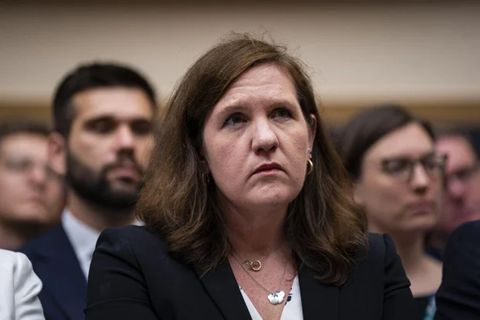
Reporter Austin Ahlman writes about how the Supreme Court’s likely overturning of Humphrey’s Executor could end agency independence and transform regulators like the FTC into direct instruments of presidential power.
Last week, the Supreme Court heard oral arguments in the case regarding President Trump’s firing earlier this year of Federal Trade Commissioner Rebecca Slaughter. The proceedings confirmed that the conservative majority appears ready to overturn Humphrey’s Executor, a 1935 precedent that protected commissioners of independent regulatory agencies from being removed from office without cause. If the Court upholds the President’s action, the decision would overturn the foundations of the system that Congress and the Executive have relied on for nearly two centuries to regulate corporate and financial power.
Unfortunately, neither the Senate as an institution, nor Democrats as an opposition party, appear to have a plan either to restore the system of independent power the next time they are back in power. Worse, they do not appear even to have begun to adjust to the radical political implications of transforming the FTC and other agencies into direct extensions of the President’s will.
The case centers on President Trump’s decision to remove Slaughter and fellow Commissioner Alvaro Bedoya before their terms expired. (Bedoya subsequently resigned his seat, while Slaughter continues fighting the unprecedented dismissal.) In the law establishing the FTC, Congress declared that commissioners can only be removed “for cause.” But the Trump administration argued that the Constitution gives the President "illimitable power of removal" over all executive officers. Based on questions from the conservative members of the bench, the Court appears likely to agree. The decision is due by the end of June but could come sooner.
The legal and economic implications of the expected opinion are vast and will reverberate for decades. For instance, the present sharp distinction between an independent agency like the FTC and a cabinet department like the State Department would vanish.
The political effects of the Trump Administration’s campaign are already playing out and require immediate action from lawmakers. Unfortunately, Democrats in Congress and Republicans who oppose this action have yet to adjust to the new reality.
For decades, for instance, Senators and interest groups treated nominees to commissioner positions as individuals who would exercise independent judgment based on their personal legal and regulatory philosophies. But that assumption is no longer valid.
Consider Ryan Baasch, the President's expected nominee to replace former Republican FTC commissioner Melissa Holyoak, recently appointed to be a U.S. District Attorney. In the past, Baasch’s heterodox views would have warranted serious debate among academics and activists. He is a former staffer for the Texas Attorney General with a history of aggressive litigation against Big Tech. Under the old rules, observers would question whether his stance on Section 230 or data privacy might open pathways for bipartisan reform. But if the Court rules as expected in Trump v. Slaughter, those questions become irrelevant. If Baasch deviates from the White House line, he can be fired immediately. His tenure will last exactly as long as his obedience.
The American public already sees this dynamic evolving in the current FTC. Under the tenure of chair Andrew Ferguson, merger approvals and enforcement actions are openly wielded as a carrot or stick against corporations vying for favor.
Ferguson’s sole remaining fellow commissioner, Mark Meador, provides an even clearer example of how quickly the tone of discussion in the FTC has changed. Unlike Ferguson, who has a long reputation as a partisan soldier, Meador was seen as a potential independent ally in fights to rein in Big Tech and protect small rural businesses.
But since the Trump Administration moved to take direct control over the agency, Meador’s personal philosophy has disappeared. He now votes consistently for the administration’s deregulatory agenda. One stark example is a recent case against Pepsi that sought to revive enforcement of the Robinson-Patman Act. After defending the merits of enforcing the law for years, Meador voted to kill a case and released an almost parodically partisan statement to justify his about-face.
This shift demands new thinking and new strategies from Democrats and independent Republicans. Senators have historically treated the president’s nominees to these boards with great deference, assuming the structure of these institutions enabled even highly partisan actors to carry out their duties faithfully and objectively. Going forward, such deference would be a strategic error.
If the Supreme Court eliminates agency independence, lawmakers must adapt. Democrats and Republicans alike must view every nominee as a direct extension of the President’s political operation rather than a trustee for Congress’s expressed intent. For the immediate future, the only way for Senators to exert any check on these agencies is to withhold confirmation and, in cases where it is possible under the law, block a body’s quorum.
Unfortunately, neither the Senate as a body nor Democratic members who oppose Trump’s actions appear to have adapted to this new reality. Last month, for instance, Senators from both parties easily advanced Republican Commissioner Michelle Stultz’s renomination to the Surface Transportation Board despite ongoing litigation over the attempted firing of board member Robert Primus. And the same day the Supreme Court heard arguments on the firing of Slaughter, the Senate Commerce Committee advanced a nominee to the National Transportation Safety Board with broad bipartisan support despite the similarly contested dismissal of Alvin Brown from that body earlier this year.
Ranking member Maria Cantwell has called for pausing proceedings on key nominees until the legality of the firings is settled. But she has thus far been unable to unify her own party around defending the legislative branch’s prerogative—let alone the opposition