The Corner Newsletter: OMI’s Paris Conference “Liberty or Monopoly?” and Fox’s Roku Purchase (October 6th, 2026)

Welcome to The Corner. In this issue, we detail our successful two-day antimonopoly conference in Paris on how U.S. tech corporations threaten human liberty and European democracy and sovereignty, and look at the potential dangers posed by Fox’s takeover of Roku.
Open Markets Cohosts “Liberty or Monopoly?” Conference in Paris
The Open Markets Institute Europe cohosted a first-of-its-kind conference, “Liberty or Monopoly? How Monopoly Power Threatens France’s Democracy and Sovereignty and What to Do About It” on September 25 in Paris. The discussion focused on the threats that market concentration and strategic dependencies pose to French democracy and independence, as well as the prosperity of the French people. OMI Europe partnered on the event with Observatoire des Multinationales and Rebalance Now. Open Markets executive director Barry Lynn and Professor of EU Law at HEC Paris Alberto Alemanno opened the conference with a fundamental question: what happens to democracy when corporations become powerful enough to constrain the choices of governments and citizens? Alemanno warned that Europe, dependent on American technology, has been slow to recognize the threat to human agency, while Lynn argued that Europe now faces a two-front challenge, with American tech giants concentrating control over information and China’s industrial power hollowing out European production.
Former WTO Director-General Pascal Lamy in a keynote said that capitalism has an inherent tendency toward concentration and that AI is accelerating it, particularly in digital markets dominated by US and Chinese firms. Lamy noted, however, that Trump’s efforts to weaken EU digital and competition policy have so far failed. Jonathan Kanter, former head of the antitrust division at the U.S. Department of Justice, in a keynote, said that competition, democracy, and freedom go hand in hand. The opening panel featured the president of the French Competition Authority, Benoît Cœuré, who warned that agentic AI could erode choice and urged policymakers to do a better job of regulating corporate power. Other speakers at the conference included Laure de la Raudière (Arcep), Romain Laleix (Arcom), Lucie Castets (Maire of the 12e arrondissement), Antoinette Guhl (French Senate), Sophie Taille-Polian (Assemblée nationale), and Cécilia Rikap (UCL). The conference received extensive coverage in Politico EU’s newsletter.
Fox-Roku Deal to Test Limits of an Unregulated Streaming Market
Karina Montoya
While Paramount’s recent acquisition of Warner Brothers Discovery has received worldwide attention, another pending deal may prove equally significant for the entertainment and news industries, a takeover by Fox Corporation (FOX) of streaming platform Roku.
Valued at $22 billion, the Fox-Roku deal might seem less significant than Paramount’s $110 billion purchase. But ownership of Roku and its 100 million streaming accounts would turn FOX into the first major TV broadcast corporation to control an infrastructure that gives it direct access to viewers. The deal would also turn FOX into both a supplier and distributor of streaming content, further blurring the lines between media businesses that were once kept separate, a trend largely driven by the Big Tech’s expansion into streaming and advertising.
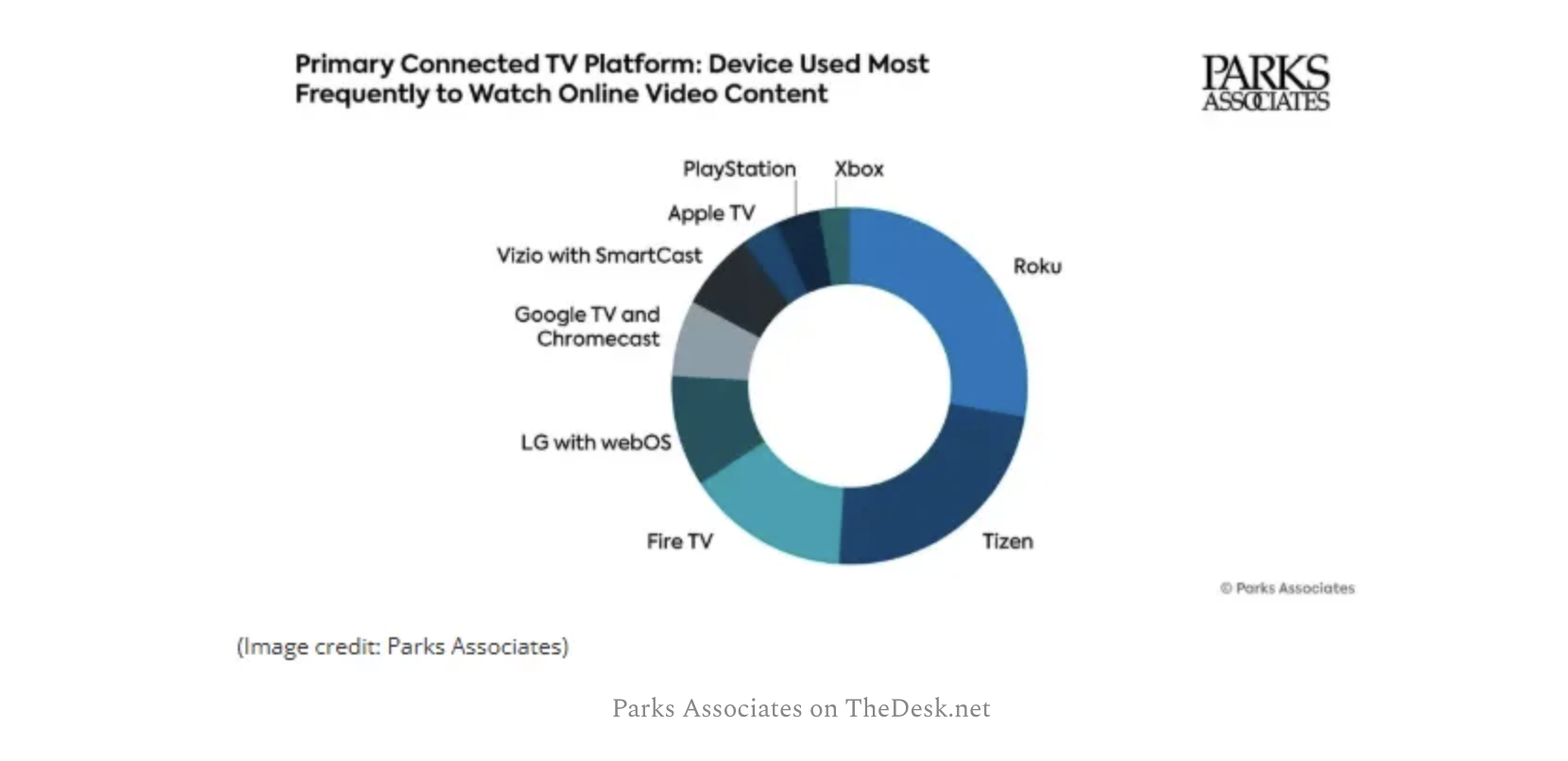
Roku is known for pioneering the connected TV market in 2008, when it launched the first smart TV with direct access to Netflix. Today, Roku’s operating system (OS)—distributed on its own branded TV sets, streaming sticks, and OS licensing on third-party TV manufacturers—accounts for 28 percent of the connected TV market in the U.S., followed by Samsung’s Tinzen OS (23 percent). Walmart also has a stake in the market, after it purchased Vizio, maker of the SmartCast TV OS, in 2024.
The appeal of companies such as Roku or Vizio is the data they capture for advertising, which is used for targeting in ways that linear TV cannot. On connected TVs, brands can show different ads to different people at the same time, and on places beyond the streamed content. For example, as background images when viewers turn on their TVs, on tiles next to the streaming apps they browse, and when they pause streamed content.
More importantly, user data captured by connected TV OS is considered “first-party data.” Since its use is unregulated for advertising anywhere online, it can be combined with as much user data provided by brands for ad targeting and improved performance tracking. The result is a supercharged version of surveillance ads that started with Google and Facebook’s harvesting data techniques across the web.
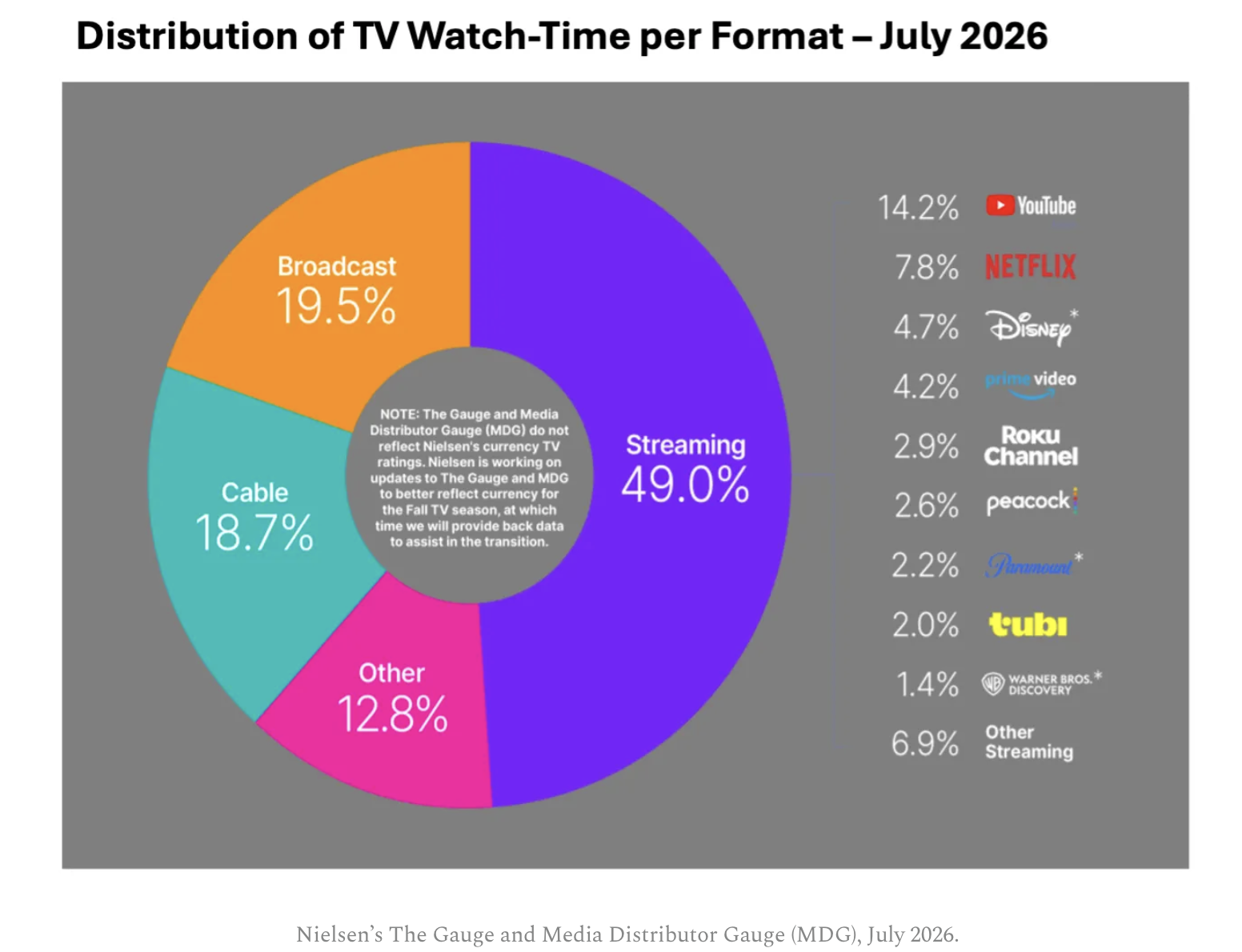
First-party data is the fuel for retail media ads, which are now growing primarily on streaming. As we previously reported, Amazon has significantly grown its ad business based on this business model. On Amazon Prime, ad targeting on live TV sports is premised on combining first-party data from its marketplace, Prime subscriptions, and AI tools backed by Amazon’s cloud monopoly, all which has awarded the corporation a 60% share of a $62 billion-worth retail media market. Similarly, Google’s YouTube—the top streaming app by TV watch time, per Nielsen—now offers similar retail media ads on mobile and connected TV, powered by other retailers’ data.
FOX is following the same playbook: getting control of more user-direct channels that yield data for ad targeting on streaming and beyond. Roku, for example, has partnerships with retailers such as Kroger, which enables Roku to offer better performance measurement by connecting ad exposure with Kroger’s in-store and online purchases. Similar to Amazon and Google, Fox will be able to seize this business model for its own live TV content.
FOX has said it will preserve the Roku brand, and that it will keep the Roku Channel and the much smaller competitor Tubi, already owned by FOX, separate. However, many already anticipate unavoidable conflicts of interest, and question whether controlling more of the connected TV market would even represent real challenge for Google or Amazon. At an investors’ call where executives from FOX and Roku discussed the deal, analysts pushed repeatedly on those issues
.The deal also does not free FOX from the grip of Google. FOX will distribute its own content and others’ content on the Roku Channel, and it will also offer streaming subscriptions (a business known as “streaming aggregation”), including to Google’s YouTube apps. But FOX will simultaneously also have to negotiate carriage fees with Google’s YouTube TV, which is already the third-largest provider of linear TV programming. To complicate matters further, FOX will also be competing with Google’s Android TV OS (known as Google TV and Chromecast).
Similar to the Paramount-WBD merger, the FOX-Roku deal is presented by executives as the optimal way to “compete” in the streaming market, against Big Tech. However, exacerbating vertical integrations that come with obvious conflicts of interests are likely to drive streaming in the same direction Big Tech has taken the open web: a tool to amass power and capture our economy, crushing challengers while exploiting users and small businesses alike.
📝 WHAT WE'VE BEEN UP TO:
Open Markets legal director Sandeep Vaheesan published a paper in American University Law Review arguing that persistent lawbreaking can itself constitute an unfair method of competition. He gave the examples of Uber, which has paid out hundreds of millions of dollars to states and workers for misclassifying its drivers as independent contractors; and OpenAI, which was charged with rampant copyright infringement by the New York Times. The American Prospect cited Vaheesan’s article in a piece on OpenAI’s predatory business model.
Center for Media and Governance at Open Markets program manager Karina Montoya published an article in Tech Policy Press on the remedies imposed in the Google ad tech case, arguing that they leave much of the corporation’s market power intact despite the court’s liability finding. “The Judge rejected almost all anti-retaliatory provisions, reduced the compliance period from the plaintiff’s proposed 15 years to Google’s six, and spared Google’s DV360 platform… from being subject to any data sharing or interoperability orders,” Montoya wrote.
Open Markets transportation policy analyst Arnav Rao warned on the Powering America podcast that the proposed Union Pacific–Norfolk Southern merger would further consolidate an already concentrated rail industry and strengthen monopoly pricing power rather than deliver meaningful efficiencies.
Democracy Journal reviewed OMI’s Sandeep Vaheesan’s book Democracy in Power: A History of Electrification in the United States, calling it an “excellent and timely read” given its relevance to current struggles among stakeholders in the power sector. “Every tactic Vaheesan documents from a century ago is still being run today even as the power sector faces arguably its biggest test since the New Deal: decarbonizing the grid fast enough to make a difference,” the reviewer wrote.
Vaheesan spoke at two recent events connecting public infrastructure, democracy, and economic power. At the Benton Institute’s conference, “A New Compact for Connectivity: Internet Infrastructure in the Public Interest,” he discussed how the history of rural electrification informs today’s push for universal broadband. Vaheesan also joined state and local elected officials at a New York City Climate Week event focused on public power and climate policy. Telecompetitor highlighted Vaheesan’s remarks at the Benton Institute event.
Open Markets Institute condemned a settlement by state attorneys general that ended their challenge to Paramount’s takeover of Warner Bros. Discovery. “By settling with Paramount, the states’ attorneys general reinforce the dangerous message that there are few real checks left on the people who aim to control every aspect of American life and culture,” said OMI executive director Barry Lynn said. Lynn blasted California’s Democratic establishment for their failure to face down corporate power, and praised the attorneys general who sought to continue the case against the takeover.
Open Markets Institute urged the Federal Trade Commission in a letter to take stronger action against surveillance pricing. OMI argued that transparency alone is insufficient and called on the FTC to investigate surveillance pricing as an unfair method of competition, scrutinize AI pricing systems and shopping agents, and recommend that Congress prohibit surveillance-based personalized pricing outright. “Americans should not have to hide the circumstances of their lives to receive a fair price,” Open Markets wrote. The letter received coverage in Targeted News Service. Read the full comment letter here.
Open Markets Institute endorsed the reintroduction of the Stop Wall Street Looting Act, legislation that would make private equity firms more accountable for the debts and outcomes of companies they control, strengthen protections for workers and consumers, and increase transparency around fees and public funding. Open Markets industrial policy program manager Audrey Stienon said companies are too often “starved by their private fund owners of the capital they need to protect the safety and wellbeing of their workers and customers.”
TVNewsCheck, in an article on whether AI companies are purchasing news content, cited Open Markets Institute’s report on the emerging AI content licensing market, highlighting OMI’s warning that news publishers face a “double bind” as the same Big Tech companies driving traffic declines also shape the terms of new licensing revenue.
The New York Post quoted from a statement by Open Markets executive director Barry Lynn criticizing the remedies in the Google ad tech case, in which Lynn called the decision to leave Google’s market power intact an “embarrassing capitulation.” The Next Web also quoted from Lynn’s statement.
🔊 ANTI-MONOPOLY RISING:
California passed a law allowing state and county district attorneys to sue individual companies for engaging in anticompetitive practices. The law updates the state’s Cartwright Act, which focuses only on the coordinated conduct of two or more companies. (Bloomberg Government)
Poland’s antitrust watchdog has launched an investigation of Google for abusing its dominance while negotiating content payments with domestic media publishers. The charges relate to how Google negotiates remuneration for displaying articles and snippets in its search results. (Reuters)
Saudi Arabia’s competition authority is reviewing Uber’s $14.8 billion acquisition of Delivery Hero, concerned over Delivery Hero’s significant market power in the Kingdom through its ownership of local food delivery platform HungerStation. This marks yet another example of a growing willingness among competition authorities outside major Western markets to address monopoly concerns in the tech sector. (Legal 500)
📈 VITAL STAT:
$250 Million
Sea Change: America’s New Great Game in the Arctic Circle — Financial Times columnist and Open Markets Institute board member Rana Foroohar narrates how melting ice in the Arctic has opened up new sea routes, contributing to the rise of conflict between great powers jockeying for trade routes, resources, and military dominance. Sea Change describes how America’s future prosperity may be at risk as control of Arctic shipping lanes, shipbuilding capacity, and underwater data cables, determines supremacy in the region.
📚 WHAT WE'RE READING:
Bytes and Bullets: Global Rivalries, Big Tech, and the New Shape of Modern Warfare — In his new book, technology and democracy expert Steve Feldstein recounts how powerful private companies, not government labs, are driving breakthroughs in new technologies, reshaping global competition in unpredictable ways and threatening democracy.