Compared to the discourse in the other party’s nomination process, the debate between Hillary Clinton and Bernie Sanders over health-care reform may have seemed thoughtful and on point.
Read More
Publications
Compared to the discourse in the other party’s nomination process, the debate between Hillary Clinton and Bernie Sanders over health-care reform may have seemed thoughtful and on point.
Read MoreFollowing its mammoth deal in China, the company has an even tighter grip on ride-sharing. It may be time for antitrust officials to step in.
Read MoreOpen Markets Food & Power reporter Leah Douglass published a story on CNN examining Bayer's announcement that it intends to buy Monsanto, the world's largest seed producer. The deal could have a profound -- and negative -- effect. In short, the $62 billion deal would further concentrate power in an already highly consolidated global seed and chemical industry.
Read MoreOne underexplored theme in the debate around economic inequality is the role of monopoly and oligopoly power. Despite the relative lack of attention to this topic, there is sound reason to believe that pervasive market power in the economy has contributed to the high level of economic inequality in the United States today.
Read MoreThe agency's antitrust policy isn’t up to the challenges of the 21st century. Here's how to fix it.
Read MoreLike many “flyover” cities, St. Louis’s decline is not mainly a story of deindustrialization, but of decisions in Washington that opened the door to predatory monopoly.
Read MoreOpen Markets Food & Power reporter Leah Douglass published a story on Fortune magazine on how over the past 10 years, America’s big meatpacking corporations have successfully pushed to overturn laws on the books protecting farmers from vertical integration and monopoly power in livestock farming and how Nebraska's "packer ban" is set to be overturned.
Read MoreExcess sugar intake is killing Americans. Open Markets Food & Power reporter Leah Douglass writes a review of Marion Nestle's "Soda Politics" on the Washington Monthly, a book which demonstrates that a few giant, consolidated beverage companies keep squashing reform efforts aimed at improving the health of consumers.
Read MoreRegional inequality is out of control. Here’s how to reverse it.
Read MoreAmerican business meets its new master
Read MoreBuried in Steven Brill’s convoluted tome are important truths about how to reform our health care delivery system.
Read MoreExecutive Director Barry Lynn wrote "Shock Therapy: Building Resilient International Industrial Systems in 2030", a chapter in Global Flow Security, which was edited by Erik Brattberg and Dan Hamilton.
Read MoreExecutive Director Barry C. Lynn writes Built to Break: The International System of Bottlenecks in the New Era of Monopoly.
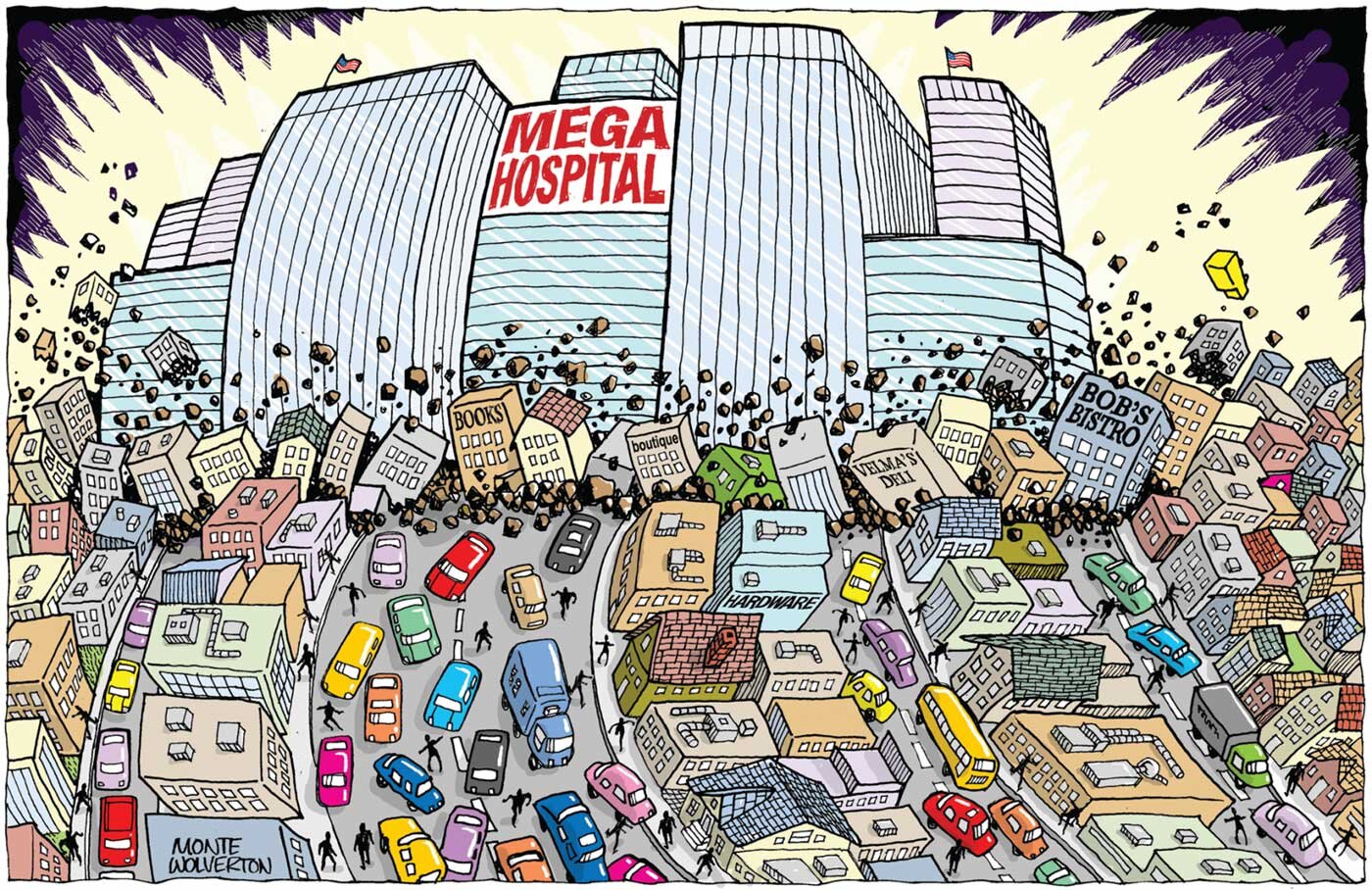
Read MoreA frenzy of hospital mergers could leave the typical American family spending 50 percent of its income on health care within ten years—and blaming the Democrats. The solution requires banning price discrimination by monopolistic hospitals.
Read MoreWhen a people set out to structure an economy, the most important decisions revolve around how they make markets and regulate competition. Such decisions determine not merely whether their economy will thrive, and how political power will be distributed. They also shape the character of individuals, communities, and society as a whole..
Read MoreIn Europe's World, Open Markets Institute Executive Director Barry C. Lynn writes that in the late 1940s, the United States adopted an industrial policy as sophisticated as any in world history. Rather than seek to build up power and wealth at home, Americans aimed instead to forge a deep and equitable industrial inter-dependence among nations.
Read MoreThe answer to America’s techno-malaise is to force big corporations to compete more. And to open their patent vaults.
Read More