
CMDG director Courtney Radsch argues how policymakers must urgently regulate the AI industry before it replicates and supercharges "surveillance capitalism" business models that commercially exploit personal data and reward psychological manipulation
Read MoreEditorial director Anita Jane argues that AI’s real danger is not superintelligence, but Big Tech’s inflated economics, concentrated power, and use of AI to turn workers and creators into tools serving machines rather than people.
Read MorePolicy and advocacy lead Giorgos Verdi argues that the EU’s Tech Sovereignty Package is a promising step toward reducing Europe’s dependence on U.S. technology firms, but warned it will fall short unless Europe also confronts the market concentration that allows Big Tech to dominate AI, cloud, chips, and digital infrastructure.
Read MoreFood systems director Claire Kelloway argues that the egg price spike was not fully explained by bird flu, pointing instead to signs that concentrated market power allowed major egg producers to raise prices far beyond what supply losses alone would justify.
Read MoreMax von Thun and Claire Lavin argue that merger guideline progress is undermined by the introduction of a bias for scale and efficiency loopholes, which give large corporations more paths to complete a merger.
Read MoreOpen Markets Europe policy analyst George Colville published a piece condemning an aggressive lobbying strategy mounted by Google and Apple to reframe interoperability mandated by the EU’s Digital Markets Act as threats to user privacy and security.
Read MoreOMI Europe director Max von Thun argues that Europe’s dependence on U.S. technology has become a sovereignty risk, as American control over cloud services, payments, chips, social media, and AI infrastructure could be weaponized for political pressure.
Read MoreIn The Times’ opinion pages, Sandeep Vaheesan and Claire Kelloway explain how runaway consolidation in our food markets has kept prices high.
Read MoreCMDG director Dr. Courtney Radch argues that Google’s AI search features amount to a content grab unless publishers can refuse AI use without losing visibility in regular search. The piece frames the UK CMA’s move as an important check on Google’s power because it separates access to search from consent to AI reuse, giving publishers more control over whether their work is used to generate AI answers.
Read MoreOMI Europe director Max von Thun speaks on how Europe is undermining its own digital sovereignty by weakening enforcement of the DMA, DSA, and competition law in response to U.S. pressure, leaving citizens, startups, and democratic institutions more vulnerable to dominant tech platforms.
Read MoreCJL Director Courtney Radsch argues that the Trump administration and Elon Musk are using regulatory power, lawsuits, and financial pressure to punish watchdogs, advertisers, and media companies that challenge powerful interests—creating a chilling effect where dissent becomes too costly, institutions self-censor, and democratic media accountability is weakened without the need for overt censorship.
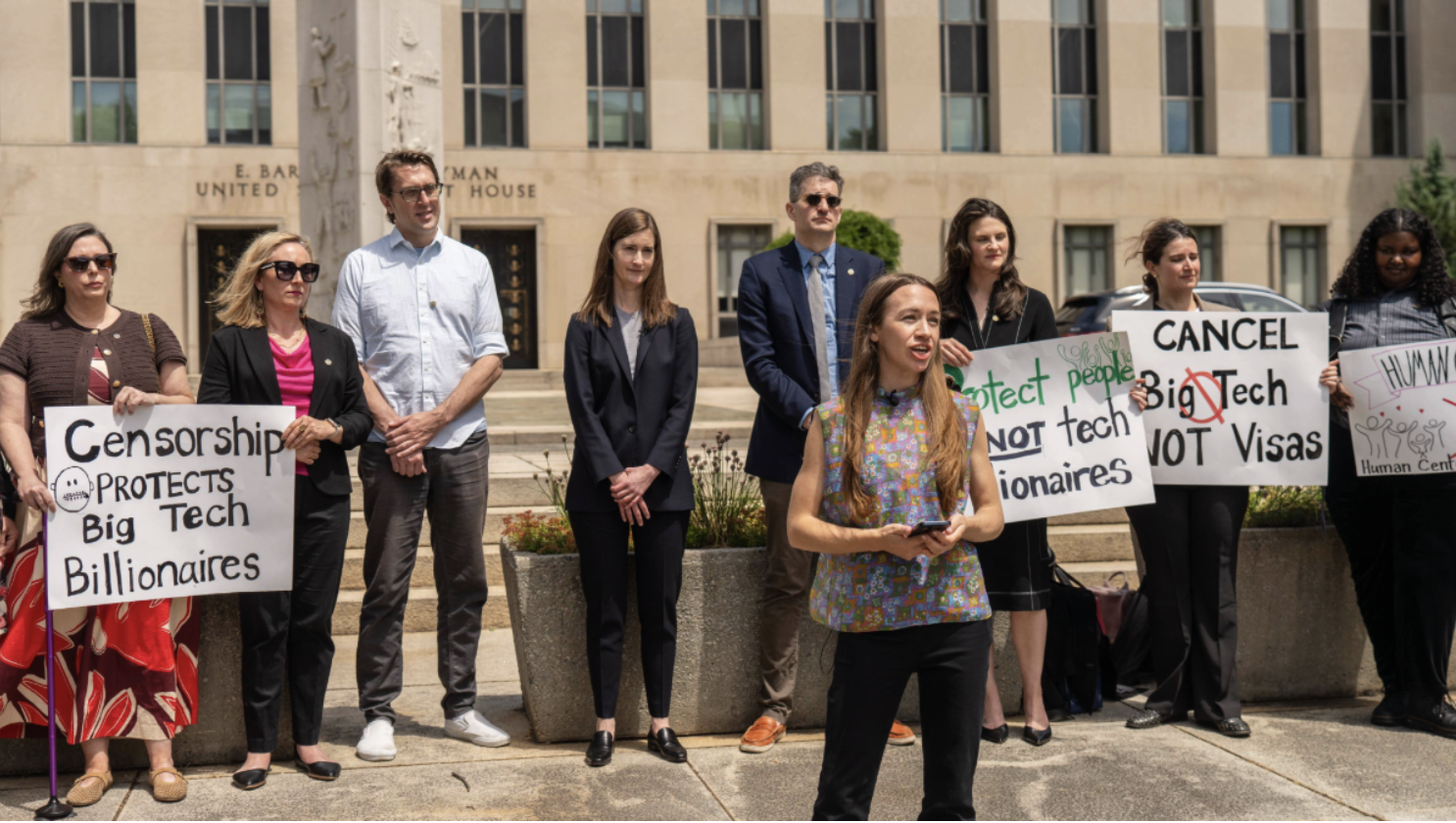
Read MoreCJL Director Courtney Radsch joins the talk on how Trump administration’s visa restriction policy targeting noncitizen researchers, fact-checkers, and trust and safety workers is a dangerous attack on independent research and free expression, warning that it could chill the study of platform harms, weaken democratic accountability, and let the government decide who is allowed to scrutinize powerful tech companies.
Read MoreOpen Markets Institute Center for Journalism and Liberty director Courtney Radsch argued that the UK failed to meaningfully address the dominance of hyperscale cloud providers, criticizing regulators for relying on voluntary commitments rather than structural remedies despite clear evidence of concentrated market power.
Read MoreOpen Markets Europe director Max von Thun argued in this co-written article that Europe has an opportunity to counter concentrated tech power and assert global economic leadership by aligning digital markets with democratic values and deeper economic integration
Read MoreTransportation analyst Arnav Rao argues that repeated global supply chain shocks now intensified by maritime disruptions expose the failure of U.S. policy to balance efficiency with resilience, underscoring the need for long-term public investment and antimonopoly industrial strategy in shipbuilding.
Read MoreLegal director Sandeep Vaheesan explains that despite weakening federal antitrust leadership, enforcement can continue through state attorneys general and private actors, underscoring that the broader antimonopoly movement does not depend solely on the executive branch.
Read MoreLegal director Sandeep Vaheesan speaks on how union-busting should be treated as an illegal monopolistic practice under antitrust law because it gives firms an unfair competitive advantage by violating workers’ rights and undermining law-abiding rivals
Read MoreLegal director Sandeep Vaheesan emphasizes that Europe doesn’t need to copy America’s model to be competitive; it should double down on strong competition policy to avoid the economic imbalances and harms baked into the US approach.
Read More