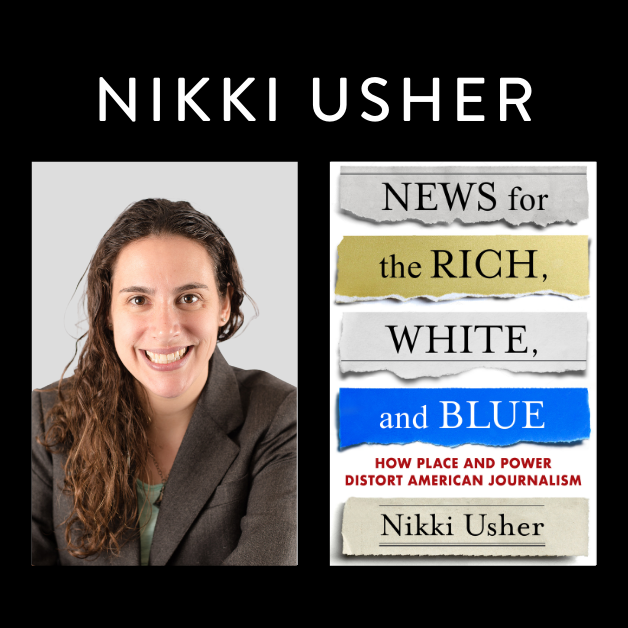
Illinois professor Nikki Usher imagines an approach to local journalism—one built on authentic, viewpoint-driven reporting upheld by readers invested in the community. Read reviews and reactions.
Read More
Publications
Illinois professor Nikki Usher imagines an approach to local journalism—one built on authentic, viewpoint-driven reporting upheld by readers invested in the community. Read reviews and reactions.
Read MoreThis report discusses how the USDA must improve regulation of agriculture markets to ensure fair competition and to counterbalance predatory corporate consolidation through statutes such as the Packers and Stockyards Act.
Read MoreOpen Markets Institute published, “Building Food Systems Resiliency Through Different Business Scales and Forms,” a report, originally submitted in response to a USDA request for comments, discussing how to improve regulation of agriculture markets to ensure fair competition and to counterbalance predatory corporate consolidation.
Read MoreWelcome to The Corner. In this issue, we discuss CJL Fellow Nikki Usher’s upcoming book, Barry Lynn’s newest publication in Foreign Affairs, the consequences and potential impact of the Supreme Court’s decision on student-athlete compensation, and congressional legislation aimed at reining in Big Tech.
Full testimony from Open Markets Institute Financial Policy Director Alexis Goldstein at the House financial services oversight subcommittee hearing, “America on “FIRE”: Will the Crypto Frenzy Lead to Financial Independence and Early Retirement or Financial Ruin?”
Read MoreAlexis Goldstein, Open Markets Institute’s Director of Financial Policy, will testify Wednesday, June 29, at 10:00 a.m. ET at the House Financial Services Subcommittee on Oversight and Investigations hearing, “America on “FIRE”: Will the Crypto Frenzy Lead to Financial Independence and Early Retirement or Financial Ruin?”
Read MoreOpen Markets Institute announces new staff member, Alexis Goldstein as new Financial Policy Director, and new board member, Deepak Gupta.
Read MoreThe Open Markets Institute releases statement applauding Chairman David Cicilline, Ranking Member Ken Buck, and members of the House Judiciary antitrust subcommittee for voting out of committee a suite of bipartisan bills aiming to rein in Big Tech.
Read MoreSandeep Vaheesan publishes a piece about how the NCAA case set back antitrust law.
Read MoreExecutive director Barry Lynn is featured in an interview with former Open Markets employee, Michael Bluhm discussing the U.S. government’s developing approaches to Big Tech.
Read MoreOpen Markets Institute sent a letter to lawmakers applauding the introduction of a suite of bipartisan bills aiming to combat the harms that Big Tech monopolies cause to all Americans, innovation, and the marketplace of ideas.
Read MoreOpen Markets Institute executive director Barry Lynn published a feature article in Foreign Affairs that details how the United States can use traditional antimonopoly principles to establish a simple quota system designed to “shock proof” international systems, strengthen democracy, and rebuild a liberal world order.
Read MoreBrian Callaci, an economist at Open Markets Institute, recently published “What Do Franchisees Do? Vertical Restraints as Workplace Fissuring and Labor Discipline Devices”.
Read MoreOpen Markets Institute notes that in its decision in NCAA v. Alston, the Supreme Court preserved the NCAA’s general collusive scheme against college basketball and football players and chose to ignore the case’s larger legal and policy implications.
Read MoreWelcome to The Corner. In this issue, we discuss the appointment of Lina Khan as chairwoman of the Federal Trade Commission and the release of five House antitrust bills aimed at taking down Big Tech.
Executive director Barry Lynn is quoted in reporting about President Biden’s appointment of former Open Markets employee Lina Khan to the Federal Trade Commission.
Read MoreFinancial Policy Director Alexis Goldstein writes about how today’s tax code incentivizes the nation’s billionaires to plow as much of their money as possible into investments in these family funds, further amplifying their wealth and giving them larger influence over the political process.
Read MoreDaniel Hanley of Open Markets Institute writes in Competition Policy International about how self-preferencing can violate Section 2 of the Sherman Act.
Read More