


Senior legal analyst Daniel Hanley and AI policy lead Arnav Rao argue that AI companies do not need an antitrust exemption to coordinate on safety, and should instead use a broadly representative, government-supervised standards body that preserves competition while setting clear safeguards for frontier AI development.
Read More
In a new policy brief, Giorgos Verdi, George Colville, and Dora Wierzbicka set out how Europe’s Tech Sovereignty Package needs to be strengthened in order to effectively reduce Europe’s dependence on foreign digital infrastructure. The Commission’s proposals contain many promising elements, but the package needs to be more ambitious, more rigorous in ensuring it does not in fact benefit existing foreign dominant actors, and more holistic in its treatment of the problem.
Read More
As debates about AI governance and transparency sweep across governments, the Open Markets Institute has joined an amicus brief urging the U.S. Court of Appeals for the Ninth Circuit to uphold California's law requiring AI companies to disclose information about the data used to train their models.
Read More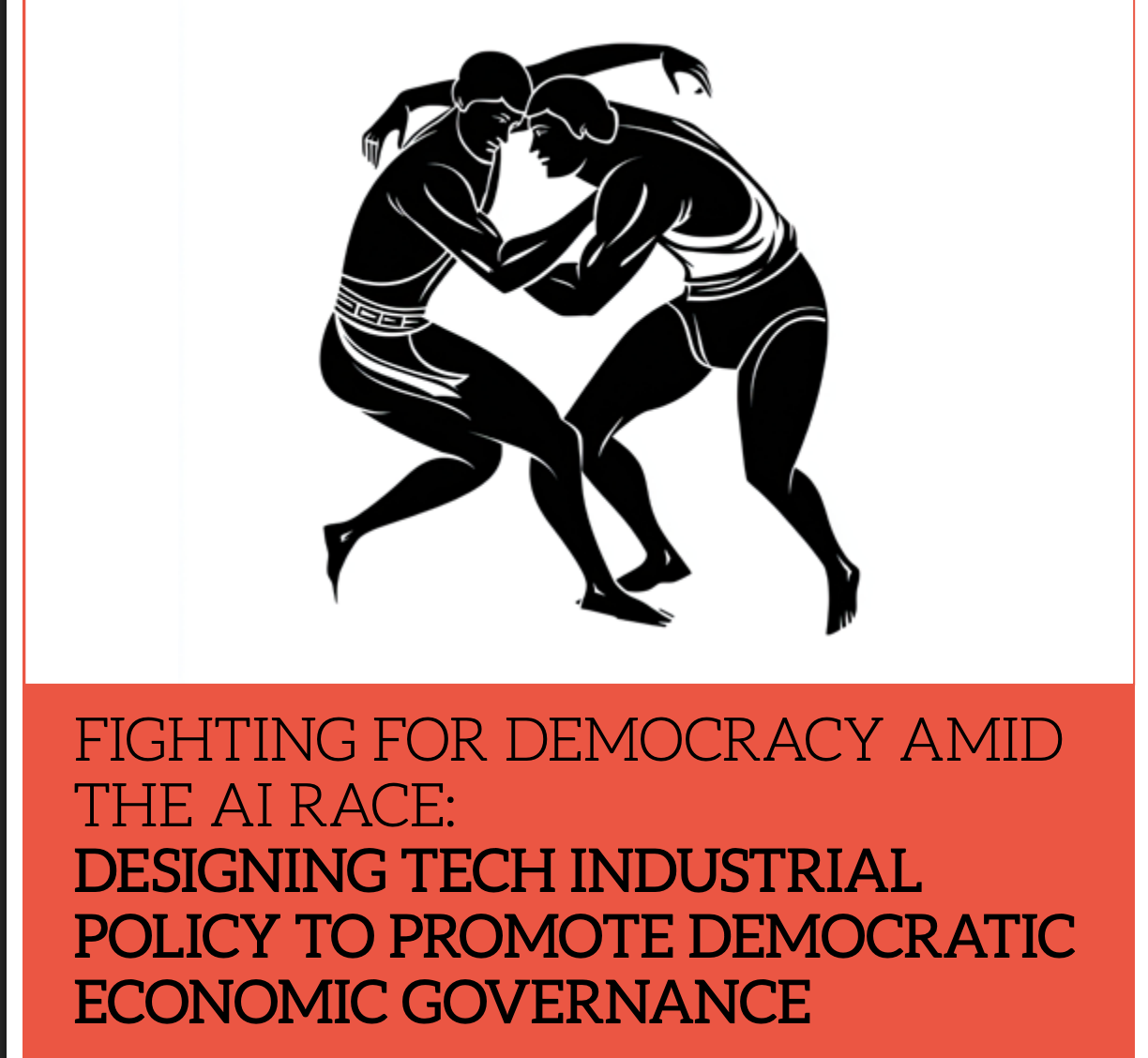
Open Markets' Europe director, Max von Thun, and industrial policy program manager, Audrey Stienon, discuss in Competition Policy International's TechREG Chronicle how AI policy narratives framed around the goal of "winning" a global race threaten to undermine the democratic values that this technology is supposed to help defend. Instead, von Thun and Stienon present a vision for an industrial strategy for AI centered on democratic governance as a means of protecting the public interest.
Read More
Europe director Max von Thun spotlights the EU’s new antitrust investigations into Google and Meta mark a crucial step toward preventing Big Tech from using its platform power to dominate AI, exploit creators, and undermine competition and democratic access to information.
Read More
In this issue, we conclude that Anthropic’s $1.5 billion class action settlement with authors whose pirated works were used to train its AI model will fail to deter the AI industry’s abusive practices.
Read More
Eileen Pomeroy argues that while the $1.5 billion Anthropic settlement offers limited compensation to authors, it fails to address broader copyright abuses in AI training—and highlights the urgent need for the news industry to organize collectively for fair remuneration.
Read More
CJL Director Courtney Radsch explains how Cloudflare's new policy to block AI crawlers by default and introduce a monetized marketplace for AI access marks a significant shift in web infrastructure, offering publishers more control and compensation but also raising concerns about the centralization of power and potential market dominance by Cloudflare.
Read More
CJL Director Courtney Radsch participates in the publication of a policy brief that G7 nations must strengthen competition oversight and adopt strict AI liability rules to curb market concentration, ensure fair access to resources, and protect consumers from high-risk AI harms
Read More
CJL director Courtney Radsch argues that AI companies should obtain explicit consent from rights holders before using their content for training AI models, emphasizing the need to respect copyright laws and protect creators' rights.
Read More
CJL director Courtney Radsch talks about explicit user consent being essential in the AI data collection process to protect individual privacy and autonomy.
Read More
Open Markets Institute’s executive director Barry Lynn called for regulators to focus on harms to democracy and human liberty.
Read More
The Open Markets Executive Director Barry Lynn released a statement on the Biden Administration’s newly-announced executive order on artificial intelligence (AI).